Jay Knott
Censorship, Fake Hate Crimes, and the Israel Lobby
A 2008 pamphlet arguing that support for the genocidal ideology of Zionism is related to the Allied narrative of WWII
Originally, this was a printed pamphlet, and a series of pages on the website pacificaforum.org. Herein, I’ve recreated it as one article.

To Preman, who first pointed me in the right direction
No copyright – this pamphlet may be reproduced in full by anyone
What is Anti-Fascism?
The phrase ‘anti-fascism’ suggests opposition to fascism. If that were all there was to it, it wouldn’t be worth writing about. Almost everyone who has heard of fascism is opposed to it. It is known as one of the main causes of World War II and the concentration camps in which millions died.
But anti-fascism has always meant more than simply opposition to fascism.
Before World War II, anti-fascism was the slogan which recruited people across Europe and America to travel to Spain to oppose General Franco’s coup against the left-wing government. It was clear even at the time to a small group of ultra-leftists in France and Italy that it was a mistake to volunteer for this apparently noble cause. Their critique sounds kind of retro today, but with the benefit of hindsight, it is obvious that they were right. Today, we can see that those who volunteered for the ‘International Brigades’ under a coalition of anarchist and communist leaders fought and died for a cause that was not only doomed, but worse than useless, even if it had succeeded.
Homage to Catalonia by George Orwell and Ernest Hemingway’s For Whom the Bell Tolls are great novels about the Spanish Civil War. They are also accurate accounts of how the Communist Party, controlled by the Soviet Union, used the volunteers as cannon-fodder, then murdered its political rivals within the left-wing coalition or abandoned them to the right-wing forces they were fighting.
So Franco won, massacred his opponents, and established a military dictatorship which kept Spain in the middle ages for forty years. What is uncontested is that he refused to enter Spain into World War II on the side of Hitler, who respected Spain’s neutrality. Had the left won the Spanish Civil War, the government would have been a puppet of Moscow. Spain would probably have been forced to enter the war on the side of the Allies, and many more Spaniards would have died.
The extent to which people were inspired by anti-fascism during World War II can be exaggerated. For example, most of the Russian soldiers fighting the Germans at Stalingrad weren’t motivated by left-wing propaganda; they were marched to the front at gunpoint. But after the war, anti-fascism was found to be useful to the victors, and given a new lease of life. During the Nuremberg trials of the Nazi leaders, if any crime could be attributed to the Allies, the USA and the Soviet Union, as well as to the Axis powers, the charge was dropped. Thus air force commander Göring was not tried for bombing cities, nor admiral Dönitz for sinking civilian ships, since the Allies committed both these war crimes too. Göring was sentenced to death for his minor role in the Holocaust, though his bombing campaigns were by far his greatest crimes.
Each country had its specific contribution to make to the war effort – the Americans had their atom bombs, the Russians liked their rape, and the Germans’ specialty was genocide. In practice, the German Holocaust was little different from what the Allies were doing at the same time: the German government murdered many innocent civilians from Germany and neighboring countries using poison gas and other methods, and the Allies did the same thing using bombs. But British schoolchildren are taken on trips to see the ruins of Belsen, but not Dresden. This one-sided interpretation of history is enforced by law in Germany and Austria. Anti-fascism has become a central pillar of the official version of history under whose influence we have all been raised. When an Australian historian was arrested in London recently for holocaust denial, it was not for denying the genocide of the Tasmanian aborigines.
Why anti-fascism, rather than anti-communism or anti-democracy? No-one actually argues that bombing people is less barbaric than gassing them, yet that is what, implicitly, we are being told when we are taught to hate Hitler but to respect Roosevelt. This is anti-fascism – not just opposition to one set of war criminals, but support for the other set. Anti-fascists cannot claim to be opposed to both sides – why would they call themselves ‘anti-fascists’ if they do not believe fascism is worse than other forms of civilization, if they do not believe that gassing Jews is worse than burning Germans to death? This immediately raises the worst aspect of anti-fascism. The phrase we have all learned, ‘The Holocaust’, means the attempted genocide of the Jews, excluding other holocausts, excluding other categories whom the Nazis attempted to wipe out, and excluding the equally monstrous crimes of the Allies. Anti-fascism discriminates in favor of Jews.
This hypocritical, self-righteous, discriminatory, racist perspective also supports vigilance (and often violence) against individuals and small groups of alleged fascists in the world today. It means exaggerating their importance, and blaming them for ‘hate crimes’, many of which turn out to be fake. We are urged to be on guard against the non-existent threat of the emergence of a major racist movement. When a lone lunatic commits a crime against a minority person, the media make out its a movement. And the reason the media exaggerate the threat of hate crimes is because it sells, and it sells because we believe – we, with our selective moral attitudes, keep anti-fascism alive:
- The US media ran a series of stories about ‘black churches’ being burned down by racists. It turned out that kids were setting fire to churches at random, indifferent to the buildings’ ethnicity.
- French Jews faked an anti-semitic attack by Muslims on the Metro – the media devoted a lot more space to the alleged attack than to the subsequent police announcement that it was made up
- A black woman in Oregon put a burning cross in her own front yard to try to claim she was a victim of racists
- Jews in London invented cases of racial harassment
- A black man was injured in a fight in an Oregon town. He told police nothing racist was said – it just happened that the other participants were white. Despite this clarification, local anti-fascists continue to use it as an example of a ‘hate crime’ in their efforts to suppress freedom of speech.
- A black teenager in New York claimed she suffered a horrific assault by a group of white men including the assistant district attorney. After an emotional campaign on her behalf by black politicians, she was found to have invented the incident in its entirety.
- A Jewish couple in Oregon set fire to their own apartment and scratched swastikas on their car and claimed it was a hate crime
- Another black woman, in North Carolina, claimed to have been raped by several white students from an Ivy League university. Despite obvious inconsistencies in her story, the police proceeded. The students were subjected to trial by media, but in the end, she was proven to be lying.
I could go on. In fact, I will. Where hate crimes are not simply invented, they are often exaggerated. A California woman was convicted of the capital crime of murder because her dog went berserk and killed another woman. The woman was criminally irresponsible in allowing a large dangerous dog to roam free, but there was not a shred of evidence she had deliberately set the dog on the victim. The reason the jury came to such an unjustified verdict was the campaign in the media to make the accident a ‘hate crime’ – the victim was a lesbian, and the dog-owner’s husband is a lawyer, some of whose clients belong to a prison gang called the Aryan Brotherhood. The murder conviction was overturned on appeal. A well-publicized case in Portland, Oregon, in 1988, where an Ethiopian man, Mulugeta Seraw, was killed, a skinhead was found guilty of premeditated murder, and a racist group, White Aryan Resistance, was sued by the Southern Poverty Law Center for allegedly contributing to his death, illustrates the dangers of exaggerating the organized racist threat. A more detailed account can be found at the end of this booklet, but to summarize:
- Seraw was killed in an unplanned street brawl, not a premeditated lynching
- It was manslaughter, not murder
- The racist group did not contribute to his death
An even graver example of what can happen when anti-fascism affects the legal system is the death of Vicki Weaver, who, with her husband and children, were besieged in a remote Idaho cabin in 1992, where clearly they were not doing anyone any harm. The FBI shot her dead while she held her baby in her arms because of the racist views of her husband. Some anti-fascists say they do not support state-organized anti-fascism. They believe ‘the community’ should confront ‘the racists’, not rely on the police to do it. They criticize the police for not going far enough. It is not clear what they would have done to the Weaver family.
But the major consequence of anti-fascism today is even more serious: it helps the state of Israel ensure the continuation of uncritical support in Western countries for its ongoing program of ethnic cleansing. Anti-fascism, by making the murder of Jews by the Germans more of a crime than the murder of Germans by the Allies, effectively implies pro-Jewish racism. Zionism is the implementation of that particular form of racism. Anti-fascism is used to suppress speech which could undermine support for Israel in the West.

A peace activist shot trying to save children from Israeli bullets
The clearest example is Germany. It is difficult to overestimate how deeply Zionism is rooted in this country, whose politicians are trying to persuade the European Union to adopt a law making it illegal to deny Israel’s right to exist – the primary victims of this law will be Muslims. This angst permeates German society, especially the left:
‘The basic opinions of the Anti-Germans include support of the state of Israel and – although this is only true for some – American foreign policy such as the 2003 invasion of Iraq, a critique of mainstream left anti-capitalist views, which are thought to be simplistic and structurally anti-Semitic, and a critique of anti-Semitism, which is considered to be deeply rooted in German cultural history’ (Wikipedia)
As a result, opposition to Zionism in Germany, one of Israel’s main supporters, is difficult, radical websites and journals have suppressed articles about Israeli war crimes and protests against them, and some Germans even commemorate the bombing of Dresden and other Allied war crimes. Why do Western countries make such efforts to prosecute Serbs for ethnically cleansing Muslims, but support Jews doing exactly the same thing? If Turkey joins the European Union, it will contain some countries in which it is illegal to deny the genocide of the Jews, and another where it is illegal to assert that the genocide of the Armenians happened!
All these aspects of anti-fascism – a lack of skepticism about alleged hate crimes, overestimating the threat of right-wing violence, a one-sided view of World War II, the belief that crimes against Jews are worse than crimes against other people, the belief that crimes committed by Jews are not as bad as crimes committed by other people, and the censorship of speech which could offend Israel’s supporters – reinforce each other.
| A Note on the Title The title of this booklet is taken from Wilhelm Reich’s book The Mass Psychology of Fascism, a product of anti-fascism in the thirties, but the content bears no resemblance, so anyone reading this pamphlet thinking they are getting a treatise on psychology will be disappointed. But having got this far, they have probably already paid for it. However, the title is semi-serious, because there is a psychological aspect to the way anti-fascism undermines a rational analysis of how Western societies work. In particular, the social pressure not to question the burden of supporting Israel is enormous, at all levels of society. How can the Anti-Defamation League, which seeks to undermine the First Amendment, the foundation of academic freedom, persuade academics to apologize for teaching students about Israel’s crimes? Why would theaters suppress a play about a US citizen murdered by the Israeli armed forces, in order to avoid hurting Jewish feelings? Why do US presidents grovel before the leaders of a far smaller country dependent on the generosity of US taxpayers? The irrational in politics is never so clear as when discussing the power of the Israel Lobby. |
Oil, War and the Lobby
Only a few years ago, because of the power of the Israel Lobby, it was almost impossible to acknowledge the power of the Israel Lobby. At the top end of American society, several politicians have had their careers terminated after mildly criticizing US Israel policy. At the other end, I remember arguing that the Israel Lobby was the main cause of the invasion of Iraq at an activist meeting.
The responses to my arguments were
- that’s ridiculous
- you’re mad
- you’re a Nazi
Since the failure of the Iraq war, it has become easier to argue that US foreign policy in the Middle East is generally subservient to the interests of a foreign power, Israel. The turning point was the widely positive reception Mearsheimer and Walt’s The Israel Lobby received when it was published in 2007, in spite of a virtual media blackout. Before explaining how Israel has become the most important consideration for US policies in the Middle East, they show how these policies cannot be explained by the phrase ‘war for oil’. This is my explanation:
Before the attack on Iraq in 2003, those who claimed it was a war for oil, which includes both supporters and opponents of war, said that conquering Iraq’s oilfields would reduce the price of oil, by increasing the supply, benefiting the economy. Following the invasion, the price of oil rose considerably, and the oil industry made record profits. The ‘war for oil’ chorus then claimed what they meant was it was a war for the oil industry. Both president Bush and vice-president Cheney used to work in that industry, you see. Say no more.
More recently, the oil industry raised the price of oil dramatically after an unusually aggressive speech against Iran by an Israeli cabinet member. This had the effect of warning the world of the disastrous economic consequences of a military attack on Iran. Price-fixing by the oil industry is illegal, so I do not for a moment suggest it was a deliberate warning.
- In the Iran-Iraq war from 1980 to 1988, the USA supported Iraq with varying degrees of enthusiasm
- The Iraqi attack on Kuwait in 1991 started as a dispute over an oilfield, but Saddam Hussein’s concern over working class unrest internally was a more important reason for the war. The US government told Iraq it would remain neutral, but after the invasion, led an international force to drive Iraq out of Kuwait. If the USA had supported Iraq instead of Kuwait, it would also have been called a war for oil, with equal justification.
- Five years after the 2003 US invasion of Iraq, some western companies are signing contracts to pump Iraqi oil and gas. For some, this is overwhelming evidence that it was a war for oil.
Paul Wolfowitz, one of the architects of the Iraq war, said it was a war for oil both before and after the invasion. Those who triumphantly cite these claims as evidence that the war was all about oil forget two things: the man is a rabid Zionist, and a congenital liar. Only about fifteen percent of US domestic oil consumption comes from the Middle East. If civilian oil was the primary determinant of US policy in the Middle East, it would have similar policies toward the oil-producing countries in the region. In fact, its policies toward the three leading Middle East oil producers are as diverse as can be: hostility to Iran, war against Iraq, and friendliness to Saudi Arabia.
The military importance of oil is a different matter. Realizing that penetrating this aspect of the ‘war for oil’ hypothesis is beyond my own modest abilities, I humbly approached the work of the esteemed Noam Chomsky. Of all the insights which this towering intellect has contributed to the community, surely none compares to his finding that military forces use lots of oil. Not satisfied with this feat of scholarship, Chomsky goes further, to note that the military consider it a good idea to grab oil for yourself whilst denying it to your enemy. So far, so good. The only difficulty is when he tries to test his theory’s predictions against actual US behavior. He claims that the USA invaded Iraq in 2003 in order to ‘control’ its oil, and that of nearby countries, for military purposes. What he somehow fails to explain is how few oil producing countries the USA has even attacked, let alone controlled, over the last century, for most of which it has been the world’s greatest power. The USA turned down an easy opportunity to occupy Iraq after winning the 1991 war. Did it really take the Pentagon until 2003 to work out that it uses a lot of oil?
To summarize, the ‘war for oil’ theory predicts that, in a conflict in an oil-producing region, the USA will support one side or the other, may occupy one of them, oil companies will invest in the region, and the result will be a rise, or a fall, in the price of oil. I won’t insult the reader’s intelligence by explaining why this invalidates the theory.
What about the ‘Israel Lobby’ theory?
The most advanced version of this theory is Mearsheimer and Walt’s. It says that the Lobby is the most powerful influence on US Middle East policy, but that the USA is capable of reducing or eliminating that influence. This theory predicts that, where the USA’s interests conflict with Israel’s, the former will usually support the latter, but that, in some cases, the USA, or parts of it, will act in its own interests.
The predictions of this theory are confirmed by reality:
a) The USA sometimes tries to restrain Israel, but is then forced to backtrack. More often, it supports Israel to the hilt, even when Israel’s actions damage America’s plans. Mearsheimer and Walt remind us that, shortly after September 11th 2001, president Bush tried to persuade Israel to call a halt to settlements in the West Bank and make various other concessions to the Palestinians, as a way of helping reduce support for Islamic extremism. Uncooperative and ungrateful as ever for the vast resources America gives it in return for nothing, Israel rudely rebuffed the world’s supposedly most powerful man, refused to meet his envoy, and forced him to drop his requests for restraint. A humbled Bush invited Israeli prime minister Ariel Sharon to the White House, and called him a ‘man of peace’. Translation: sorry for the interruption, keep on killing, we won’t interfere again.
b) But, as the theory predicts, there are exceptions. The most outstanding is America’s cuddly relationship with Saudi Arabia, a country with a dim view of Israel. Though the US does not give to the Saudis vast quantities of the most modern weaponry, as it does to the Israelis, it does sell them warplanes and co-operate with them in numerous other ways, to the chagrin of Zionists, liberals and Osama bin Laden.
Chomsky doesn’t like the Israel Lobby theory. He assumes that Israeli and US interests coincide. His blind spot derives from treating the US political system as, well, a system. Picture a visitor from another planet looking at a car traveling slowly, making a loud noise, and emitting a lot of black smoke. The alien, using his x-ray vision, analyzes the car’s engine, carburetor and spark plugs, and describes how the vehicle is perfectly designed to travel slowly, make a loud noise, and emit a lot of black smoke. This analogy illustrates the logical fallacy called functionalism – you cannot say if a system is functioning correctly unless you know what it is designed for. For Marxists, the system is the executive committee of the ruling class – it serves capitalism. For liberals like Mearsheimer and Walt, it is supposed to serve ‘the people’. Chomsky does on occasion admit to the influence of the Israel Lobby in the USA, but his theory only allows him to see it as part of the system – he says the Lobby makes the system act in its own interests – by supporting Israel. He notes that the USA often approves Israeli actions in advance – and concludes that shows that Israel obeys the USA. Mearsheimer, Walt and I have proven him wrong – on numerous occasions, when Israel has acted, US politicians, including presidents, have made mild criticisms, the US Israel Lobby has mobilized, and the US politicians have apologized. Unless you believe that this is an elaborate charade to cover the fact that Israel obeys the USA, you find the Israel Lobby is like the engine of a car traveling slowly, making a loud noise, and a lot of black smoke.
On the website Counterpunch and elsewhere, Michael Neumann, Jeffrey Blankfort and others have run rings around the party line defended by Chomsky and similar hacks, that Middle East policy is primarily about oil, elites and hegemony. The complacent platitudes of Chomsky and his disciples are not merely mistakes, nor merely products of dishonesty – there is an element of consciously avoiding a challenge to the power of the Lobby because of cowardice – they refuse to debate the question. Leaving these faint-hearts behind, we – the vanguard – defend the view that, thanks to its Lobby, the greatest influence on US policy in the Middle East is that of Israel, a foreign country with completely different interests, at the expense of good relations with nations and movements with similar interests, and lots of oil.
Whether you believe the US political system is designed to serve the interests of the capitalist elite or the interests of the huddled masses, no honest observer can avoid the conclusion that the Israel Lobby is dysfunctional for that system: the tail wags the dog. The dogma that Israel is a strategic asset of the USA is a dangerous error, because it makes opposing uncritical support for Zionism sound more difficult than it actually is. Some of Chomsky’s followers go so far as to claim that Israel is a victim of US policies in the Middle East – by ‘goading’ it to drop cluster-bombs on Lebanese schoolchildren, the USA forces Israel to stir up hatred against itself, taking the heat off the USA. I’m not making this up.

None of this means the war in Iraq has really benefited Israel. Mearsheimer and Walt argue that the US Israel Lobby is not a perfect cipher for Israeli interests: the Lobby was the prime mover of the Iraq disaster. If Iraq is a little confusing, the case of Iran is clear as glass: US and Israeli interests are completely different. The USA can choose whether to be on good or bad terms with the Islamic Republic, basing its choice on calculated self-interest, whereas Israel faces the problem that Muslims cannot, on principle, recognize a Jewish state on their land. When vice-president Dick Cheney was a businessman, he opposed sanctions against Iran, on the grounds that they are bad for business. When he became a politician, dependent on the democratic system, he had to support sanctions and warmongering. When George Bush Senior was standing for re-election, he had to apologize to the Lobby after he mentioned its influence and was accused of anti-semitism. Jimmy Carter, subjected to the same outrageous slander, did not have to apologize, since he is not seeking office. Bush Junior was able to defy the Israeli war drive against Iran during 2008 for the same reason.
Giving the lie to Chomsky’s ‘analysis’, big corporations and some of the undemocratic parts of the state, such as the intelligence services, are currently more likely to resist the war drive than the elected bits, which are most subject to the pressure of the Israel Lobby. It was the combined weight of all sixteen American intelligence services which leashed the dogs of war at the end of 2007 with a devastating report which said that Iran has no nuclear weapons program. The Lobby was furious – the centerpiece of its war drive, after the exposure of its lies about Iraq, was a stream of fabrications about the Iranian menace – but there wasn’t much it could do until the election season came around the following year, when it made the candidates for president appear at its conference and compete with each other to make fawning speeches in support of Israel.
The question has become not if Israel is the primary influence on US policy in the Middle East, but how. We have a partial answer in the Mearsheimer and Walt bestseller – it’s the Lobby’s mastery of the electoral process. But this wouldn’t work if the allegation of ‘anti-semitism’ directed at any legislator who makes a mild criticism of Israel and its Lobby were ignored, as they would be if the democratic system was simply a tool of the ruling class. It’s the irrational deference to Israel which needs explaining. This pamphlet is intended to be a modest step forward – by mixing the critique of anti-fascism developed in the thirties with anti-Zionist theory and a bit of half-serious psychology, I hope to stimulate readers to think critically about this difficult question.
The inability of today’s activists to challenge the Israel Lobby goes some way toward explaining the absence of an anti-war movement today. In the seventies, the American ‘movement’ was the envy of the world, as it helped end the Vietnam war. Did the rise of sensitivity, the notion that how someone feels about an issue is as valid as a scientific fact, make this movement more, or less, effective? The Lobby is not only a key issue in opposing war today, it is also the most effective litmus test separating those who want to change the world from those who want to feel good about themselves.
| coward caitiff (archaic) chicken (slang) craven, dastard (archaic) faint-heart, funk (informal) poltroon, recreant (archaic) renegade, scaredy-cat (informal) skulker, sneak, wimp (informal) yellow-belly (slang) |
Anti-Fascism: Pro-Zionism
Many of those who follow anti-fascism would deny they are allies of the Israel Lobby. They believe they are just as much opposed to the oppression of Palestinians by Jews as they are opposed to white supremacy in Western countries. But, just as it was not possible to fight against Franco in Spain in the 1930’s ‘autonomously’ of the communist party, so today one cannot consistently single out fascism as a unique evil without simultaneously abetting the influence of Zionism. This consequence is quite logical: anti-fascism promotes the idea that murdering Jews is worse than murdering German or Japanese people. This is pro-Jewish racism. Support for the ethnic cleansing of the Palestinians follows as night follows day.
Liberal anti-fascists don’t realize this, but Zionists certainly do. Roughly speaking, anti-fascists can be categorized as follows, in increasing order of their grasp of logic:
- Radical anti-fascists, mostly anarchist
- Liberal goody-goodies, with names like ‘The Coalition for Human Dignity’
- Nationwide Zionist pressure groups such as the Anti-Defamation League
These different strands of anti-fascism have more in common than they admit –
- they greatly exaggerate the danger from white extremists
They support the moral panics which frequently appear in the media, alternative and corporate alike, claiming fascists are about to make an appearance. A few years ago, the good people of Portland were urged to gather in Gabriel Park, a wealthy part of town, to head off a rumored invasion by ‘Nazi skinheads’, who, it was claimed, would represent a danger to the Jewish population of the area. As if the police would allow teenagers, even those with unorthodox views on German history, to terrorize a well-heeled district. Claims of racist activity in poorer, blacker areas are more plausible, but here, too, anti-fascism exaggerates. When a shotgun was fired randomly at a house in North Portland, and some white kids were arrested for the offense, ‘Hate-Free Zone’ posters appeared, and the local TV, newspapers and alternative websites buzzed with excitement, as if one random, victimless shooting was another Kristallnacht, though there was no evidence of racist intent. Yet when a black youth shoots another dead, the silence is deafening. Another aspect of the inherent racism of anti-fascism is shown – ‘black-on-black’ violence is not important to anti-fascists. This bias mirrors the attitude of traditional racists that what ‘they’ do among themselves doesn’t matter to ‘us’. If Ethiopian Mulugeta Seraw had been killed by African-Americans, or if he were white, he would not have become a cause célèbre. - they are deliberately vague about what crimes these ‘Nazis’ are guilty of
Anti-fascists write and talk about ‘Nazi activity’, consciously blurring the distinction between expressing an opinion and conspiring to commit criminal violence. Expressing the view that races are more important than they really are, and that some are more important than others, is not a crime, neither in law nor in reality. Those who want to ban racism on the grounds that it spreads ‘hate’ could easily go on to ban Marxist and similar ideas which promote class conflict. Moreover, it is wrong in principle to ban racist theory. A scientific approach to racism says it is unlikely that a racist theory is both valid and true. Anti-fascism cannot tolerate this ambiguity. James Watson, one of the discoverers of the structure of DNA, was fired for saying that some racist ideas might be true. Zionism should not be suppressed on the grounds that it is racist. Whether the USA will indefinitely tolerate agents of a foreign power actively undermining its constitution is another matter. - they tell lies about their opponents
One of the techniques used by anti-fascists is to smear all their targets as ‘Nazis’. Any historian who doubts the official story of The Holocaust in all its gory detail, lampshades and all, is condemned as a Nazi sympathizer. In Britain, the ‘Anti-Nazi League’ claims that the British National Party is ‘Nazi’. This used to be almost a half-truth. The BNP’s predecessor, the National Front, was founded by outright National Socialists. There are photographs of these clowns wearing Nazi uniforms – in Britain in the nineteen-fifties! It took a long time to live that one down – but the BNP finally found an opportunity to break with its anti-semitic antecedents, in the war on terror. In 2006, following the Israeli attack on Lebanon, the BNP enthusiastically supported it, seeing it as part of the war against Muslims at home and abroad, and made a final purge of anti-Jewish attitudes amongst its membership. For the BNP, support for Israel went along with abandoning anti-semitism. - they attempt to police all opponents of anti-fascism, not just fascists
Anti-fascists are in favor of suppressing debate. Their position ‘No Platform for Racists’ gives power to those who define what is racist, the product of negotiations between leftist hacks and Zionist lawyers. They don’t want you to read this pamphlet. It’s not that they disagree with what I say – they want to suppress it altogether, so you can neither agree nor disagree. The editors of the Indymedia left wing websites have deleted articles which they claimed were racist, but which clearly weren’t. It is easy to predict how anti-fascists will distort the argument in this pamphlet. They will claim I am saying ‘Zionists will accuse us of anti-semitism anyway, so we may as well be anti-semitic’. This is not the case.
Anti-fascists make great efforts to persuade us that they are not aiding ‘the state’ in general, seemingly unaware that their lies and distortions serve the interests of one state in particular. They encourage attacks on fascists, legal and otherwise, on the grounds that fascists spread violent ideas, but do nothing to oppose Zionists doing the same thing, on a bigger scale, and with more effect.

celebrating the death of Rachel Corrie, a peace
activist killed by an Israeli bulldozer
When the Southern Poverty Law Center and the Anti-Defamation League decided to use the death of Mulugeta Seraw to attack freedom of speech, they chose to prosecute the White Aryan Resistance, not because this group was actually involved in Seraw’s death, not because they thought this prosecution would prevent further deaths, but because fascists are, to say the least, unpopular, so the public were more likely to tolerate this blatant attack on the First Amendment. Following this victory for anti-fascism, Zionists started a campaign to purge academia of critics of Israel. Some were fired, others forced to say they would stop spreading ‘hate’ in order to keep their jobs. Some even adopted Chomsky’s views. As a result of its decision to tackle the Israel/Palestine question, the University of Oregon’s Pacifica Forum is currently subject to a campaign by the SPLC and the local anti-fascists of the ‘Anti-Hate Task Force’ to smear it as anti-semitic and persuade the University to close it down, by linking it to a series of alleged ‘hate crimes’.
Anti-fascism, by its nature, is part of the fabric of emotional manipulation which gives Israel more funding from the USA than all other countries put together. This is what gives Israel its license to kill, and its ability to suppress freedom to criticize it. Opposition to this machinery of repression, hate and war cannot be combined with spreading the ideas which support it, or the emotions which support the ideas which support it.
Racially-motivated violence is not the major form of violence. Even at its height, skinhead violence was not the number one killer. Why not campaign against other social phenomena which cause violence, such as the illegality of drugs? The appeal of anti-fascism is not rational calculation of what is the greater social evil. Its appeal is that it gives you a warm fuzzy feeling – you can feel you are fighting against racism, one of the most pernicious aspects of this society, while in reality you are doing the exact opposite. Mountaineers know that a warm fuzzy feeling is the penultimate stage of hypothermia. They also know to hang on to their icepicks when navigating a slippery slope…
First We Take Manhattan
Defenders of Israel routinely try to disarm its critics by accusing them of anti-semitism. But most critics of Israel are simply opposed to the crimes of this state, not to the ethno-religious group to which many of its inhabitants belong. It is like saying that the movement against apartheid was motivated by prejudice against the Afrikaaners, the Dutch-speaking white South Africans who supported it. One of the main motives for opposing Israel or Israel’s behavior is opposition to racism, since it is as clear as day that one of the main characteristics of the state of Israel is its racism – it favors Jews over Palestinians, to put it mildly. But the US government has consistently opposed the characterization of Zionism as a form of racism on the international stage – the opposite of its behavior regarding racial segregation in South Africa. Yet, in contrast to Israel, the USA had an interest in supporting the South African apartheid regime, which fought Russia’s allies in Africa. This divergence cannot be explained by calling it ‘capitalism’ – why is the USA so supportive of Israeli capitalism, when it was so critical of apartheid capitalism? All the ‘materialist’ explanations of the West’s support for Israel amount to circular arguments, and should not be taken seriously: behind the absence of logic is a lack of valor.
The problem is emotional and psychological. Even when allegations of anti-semitism are ridiculous, we tend to take them seriously, because of the pro-Jewish racism which is embedded in our culture. As a result, pro-Palestinian activists make an effort to deny that they are anti-Jewish.
There are some important exceptions, who have consciously rejected being concerned about the danger of anti-semitism in the Palestinian solidarity movement. One example is Gilad Atzmon, an ex-soldier from Israel, and a major jazz musician. In a witty and provocative way, he says we tend to be more concerned about the false issue of anti-semitism than we are about the real issue of Jewish racism. Furthermore, he argues that it is impossible to be an anti-Zionist, non-religious Jew. He says there are three kinds of people in the world who identify themselves as Jewish –
- Zionists
- Religious Jews who oppose Zionism for theological reasons
- Secular Jews who claim to be against Zionism but aren’t really
Not surprisingly, this hypothesis was unwelcome to groups like Jews Against Zionism, who denounce Atzmon around the Palestine solidarity movement as ‘a notorious anti-semite’. Frequent ‘demands’ are made that he be banned from this meeting or that website, because he criticizes Jewish identity as such, not just its most successful product, apartheid in Palestine. Just as the Israel Lobby proves its power by suppressing those who criticize its power, so Atzmon’s opponents show their chutzpah by censoring those who criticize their hypocrisy.
Another good example in support of Atzmon’s thesis about the vacuity of Jewish anti-Zionism is the case of Lenni Brenner, whose Zionism in the Age of the Dictators is available on a German website, marxists.de. Brenner shows how Zionists, far from being defenders of the Jewish people, collaborated with their worst enemies, the Nazis. Particularly gruesome is the example of Hungarian Zionists, led by Rezso Kasztner, arranging to have 600 Jews saved, to travel to Palestine, in return for abandoning 450,000 to their deaths. The Zionists were more concerned about creating a Jewish state than they were about saving Jewish lives. Brenner’s aim is to turn Jews against Zionism on the grounds that it sometimes goes against their interests. This won’t wash. In the first place, Zionists could answer, ‘yes, we did collaborate with the Nazis during World War II, but we have learned since then never to give an inch to our enemies (the Palestinians, the Iranians, the goyim)‘. But more importantly, Brenner’s argument amounts to saying ‘Don’t support the Zionist gang of ethnic cleansers, murderers and promoters of a nuclear holocaust – they collaborated with the enemies of the Jews!’. Which implies that, if these ethnic cleansers, murderers, and holocaust-mongers didn’t collaborate with Jews’ enemies, they wouldn’t be so bad. Brenner’s argument is tactical: Zionism was a bad tactic from the viewpoint of Jews. He tries to persuade Jews not to support apartheid because it doesn’t work. Brenner showed his true colors when he joined the ranks of those ‘demanding’ the suppression of Atzmon’s articles, to protect you and I from his treif thoughts.
In a similar sleight of hand, Noam Chomsky claims that the ‘apartheid wall’ which Israel constructed in the West Bank is designed to steal Palestinian land and water, not for Israel’s security, as the government claims. He employs the logical fallacy known as a ‘false dichotomy’ to do this – pretending that the wall is either for security or for robbing the Palestinians. In fact, it does both, but its primary purpose, in which it has been highly successful, is to defend Israelis against suicide bombers. Chomsky can’t admit it is for Israel’s security, and condemn it too. Some of his adherents criticize Israel’s policies of murder, torture and so on, on the grounds that they are bad for its security. In other words, if they were good for Israel’s security, they would support them.
Like Atzmon, Jeffrey Blankfort, one of America’s brave critics of Israel, argues that it is very difficult to have a Jewish identity separate from Zionism:
‘The distinction that we are always careful to make between being Jewish and being Zionist is essentially deceptive and that while all Jews are not Zionists, the organized Jewish communities throughout the world, despite whatever differences they may have, are totally behind the Zionist project.’
Do I agree? I don’t know – but I’m not going to allow fake anti-Zionists to prevent me from finding out by blackmailing me with fear of anti-semitism. It is this irrational fear which holds us back from effectively challenging Zionism.
URL of Duke
The following quotation typifies the apologetic attitude to Israel which I believe has been a major obstacle to the success of Palestinian solidarity:
‘Unfortunately, groups that assert Palestinian human rights and criticize Israel often attract and can be co-opted by people holding anti-Semitic and other racist viewpoints… That allows legitimate and necessary criticism of Israel’s policies to be dismissed as anti-Semitic by Israel apologists, denying Israel the corrective feedback that might save it from the worldwide disrespect it now suffers and the self-degrading and ultimately self-destructive path it has pursued from its beginnings…’
This is from a letter to an Oregon newspaper. You can find variants of it all over the place. It argues that the Palestinian solidarity movement needs to demonstrate its moral purity to the ethnic cleansers of Palestine. Israel’s supporters have already successfully labeled its critics as anti-semitic and rendered sympathy for the Palestinians completely ineffective throughout the Western world. How could the solidarity movement be less effective if it were less concerned about anti-semitism?
An academic in Britain was suspended from her union after posting a link to an article on a fascist website, which she found by googling the phrase ‘humanitarian disaster in Gaza’. She didn’t know it was run by fascists – she just read the one article, and it contained nothing offensive. Zionists and leftists in the union saw her link and went ballistic, and she apologized – but they didn’t reinstate her – an example of the futility of kowtowing to these people. A better approach would be to insist on her right to link to whomever she likes. Is it her fault if some opponents of Israeli influence are fascists? The union, the Universities and Colleges Union, was the first to call for a boycott of Israel, but it lacks the courage to stand firm against the predictable chorus of ‘anti-semitism’. The union gives Zionists the message that it will try hard to satisfy their complaints. Almost all of Palestinian solidarity waves the same white flag.
Suppose you found a coherent article by a fascist containing valid arguments about the Israel/Palestine issue? Are you worried that you will accept everything fascists say if you accept anything they say? Or are you really afraid of what people might think? I know I am – of course Zionists and their friends would distort what I am saying, would use my reference to a fascist article to try to claim that I am a fascist myself. But that is going to happen anyway. I have already been accused of anti-semitism by more than one ex-comrade. I don’t waste time trying to placate Zionists and their poodles.
Mearsheimer and Walt cringe when critics point out that their The Israel Lobby was well-received among fascists, but they should stand their ground. Instead of apologizing and backtracking, we should oppose the Zionists as provocatively as possible. It’s not just what you say, it’s how you say it – we should make clear our contempt for Israel’s fifth column in the tone as well as in the content of our message.
A play about Rachel Corrie, an American peace activist killed by the Israeli army, was called off in several North American cities out of concern for the sensitivities of Jewish groups. For those who would like to see the play, there are two possible responses. One is to argue rationally:
‘Theaters gave in to Zionist pressure, not Jewish sensitivity – many Jews are deeply concerned about Israeli atrocities…’
The more effective approach is to become insensitive.

An admirable example of a step in the right direction is the response of the anti-war discussion group ‘Pacifica Forum’ at the University of Oregon to Zionist critics who labeled it anti-semitic in the local media. The Forum invited holocaust revisionists – historians who question aspects of the official holocaust narrative – to talk about the Israel Lobby and freedom of speech. As a result, the Southern Poverty Law Center has added the Pacifica Forum to its list of ‘hate groups’. When the SPLC, one of the Lobby’s poisonous snakes, crawled out of the swamps of Alabama and slithered in our direction, we felt shivers of both revulsion and excitement. How different from the situation at the same university four years earlier, when a professor was accused of anti-semitism, and ended up signing an agreement repeating the lies of anti-fascism, expressing
‘…his horror at the wave of anti-Semitic events around the world in recent years’
The Palestine Solidarity Campaign in Britain showed the same paralyzing deference to the feelings of sensitive Jewish princesses by wasting valuable time discussing whether to invite Gilad Atzmon to its conference, because it took the allegations of anti-semitism seriously. Indymedia deleted an article by me, because I argued that anti-semitism is no big deal, which they interpreted as promoting it. The editors of this site are so pro-semitic they interpret indifference as antipathy.
Palestinians too suffer from sensitivity. For example, Yasser `Arafat said
‘Zionism is an ideology that is imperialist, colonialist, racist; it is profoundly reactionary and discriminatory; it is united with antisemitism in its retrograde tenets and is, when all is said and done, another side of the same base coin’
How fair-minded this sounds in comparison to the lies Israel heaped on `Arafat’s head. How balanced and objective. How warm and fuzzy. And how wrong! One problem with this approach is its lack of proportion. Zionism and anti-semitism are not two sides of the same coin – Zionism is much worse than anti-semitism. Anti-semitism today doesn’t result in gas chambers, as it did sixty-five years ago, but Zionism is killing people right now, with bullets, bombs, starvation and disease, and suppressing our ability to stop it, with censorship and blackmail.
The idea that anti-semitism and Zionism are on the same side is only true in the sense that all violently opposed forces reinforce each other. Of course Zionism helps encourage anti-semitism, and benefits from it – but its main products are murder, dispossession and forcing children to grow up in a concentration camp, the Gaza strip, and in similar conditions in the West Bank and in refugee camps in neighboring countries. The fact that some of the children who survive this experience grow up with an attitude toward Jews is hardly the main problem. It is an inconvenient truth that for a section of the Western public, an increase in anti-semitism would lead to a decrease in support for Israel, so Zionism and anti-semitism are sometimes on opposite sides of the fence, rather than two sides of the same coin. It follows that it is impossible to be equally opposed to Zionism and to anti-semitism. To oppose the influence of Israel, to undermine support for ethnic cleansing and war in the Middle East, it is necessary to abandon anti-fascism and everything that goes with it.
First, They Came For The Fascists…
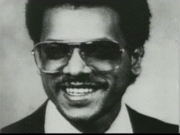
An instructive example of a moral panic which united the police, the left and the media in an anti-fascist witch-hunt against hate crimes is the case of Mulugeta Seraw. In 1988, in Portland, Oregon, Seraw, an Ethiopian immigrant, was killed in a drunken dispute over a parking space. Four skinheads were convicted of murder, one of them, Kenneth Mieske, sentenced to thirty years in prison, and the organization White Aryan Resistance was successfully sued for $12.5 million by the Southern Poverty Law Center and the Anti-Defamation League. Elinor Langer’s book about the case, A Hundred Little Hitlers, is a rare example of authentic journalism – she even spells Blood and Honour correctly. More importantly, she goes beyond her own liberal attitudes, and discovers that:
- Seraw was killed in an unplanned street brawl, not a premeditated lynching
- It was manslaughter, not murder – this distinction is very important in the USA, where a conviction for first-degree murder is very difficult to live down, especially if you are executed
- The Southern Poverty Law Center was lying when it claimed that White Aryan Resistance sent agents to Portland to commit racially-motivated violent crimes – in truth, despite its name, WAR carefully avoided illegality
- The prosecution of WAR set a precedent whereby civil law can be used to convict someone of what is really a criminal offense, with a much lower standard of proof
The fascists lost the case because of the hysteria stirred up by the media, politicians, the police and anti-fascists, and because they could not afford a lawyer to counter the wealthy Zionists who prosecuted them. And, it has to be said, because they are not the sharpest tools in the shed.
Neither are some anti-fascists. Those who have read Langer’s analysis don’t understand it any better than the people who wrote the book’s cover notes or the reviewers in the local press, which give the impression that she blindly follows the anti-fascist party line. A good example can be found in an article in the Portland anarchist magazine Little Beirut which simply repeats the SPLC’s distortions in more radical-sounding language (president Bush once described Portland as ‘Little Beirut’, though ‘Little Tel Aviv’ would be nearer the mark). The article, Anti-fascist organizing in Portland 1988-1993, contains no trace of an admission that Mieske’s conviction was unjust, nor that there is anything wrong with evicting a family from its home for its opinions – instead, it celebrates the persecution of Mieske and WAR, and complains that the SPLC’s attack on freedom didn’t go far enough:
‘Tom Metzger, who rightfully occupies center stage in her book, may have been convicted in trial and Ken Mieske, who killed Mulegeta Seraw, may be rotting in Oregon State Penitentiary, but white supremacy and the neo-fascist movement were untouched by the legal machinations.’ |
I hope readers don’t think I chose Little Beirut deliberately because it is so imbecilic, in order to discredit anti-fascism. I recommend the New Abolitionist group as a more coherent example of a bunch of do-gooders who have listened to too many Neil Young albums, flogging the dead horse of white supremacy –
- James Watson, the discoverer of the mechanism by which genetic information is transmitted, lost his job for suggesting that black people might be less intelligent than white people. This genius, whose contribution to understanding life is only surpassed by Darwin and perhaps Mendel, had a lecture tour of the UK canceled, and when he returned to the USA, was fired under pressure from the thought police.
- people have been evicted from their home for expressing pro-white racist opinions
- a woman was murdered by the FBI because her husband was a white separatist
- when liberal academics Mearsheimer and Walt appeared in US cities to promote their bestseller The Israel Lobby, attempts to publicize the event in the local media were often censored
- the murder of an American woman by the Israeli army is described as ‘controversial’ in the US media – just like the bombing of Dresden
- fascists fare less well in court cases than anti-fascists
- implausible accounts of hate crimes are taken seriously by the police
If the North Carolina cops can be politically blackmailed into framing rich white kids on behalf of a clearly unreliable black witness, white power is not the problem. One indication that Jewish, and not white, privilege is more powerful, is how difficult it is to oppose the former, and how easy it is to oppose the latter. This difficulty is both social and psychological. You will get into trouble if you concentrate on criticizing Israel and its supporters. It is also psychologically difficult, even to say the phrase ‘Jewish supremacy’, despite the fact that is obviously as valid a concept as ‘white supremacy’. Today, anyone who argued for the return of apartheid in South Africa would be called a ‘white supremacist’, without hesitation. Supporters of the master race in Israel today should be called ‘Jewish supremacists’, with equal justification, but they are spared this unflattering deconstruction. This in itself is evidence of Jewish privilege. If you held a meeting about white supremacy, the meeting would not be besieged by white supremacists claiming that white supremacy does not exist. If you held a meeting about Jewish supremacy, you would be besieged by Jewish supremacists claiming that Jewish supremacy does not exist. Even if you believe that ethnic privilege and oppression are not particularly useful concepts, it is still revealing that some of these concepts are easier to discuss rationally than others.
The phrase ‘Jewish supremacy’ clearly describes the situation in the Middle East – one small group gains advantages by racially oppressing the rest of the population. The term ‘Jewish privilege’ is more accurate to describe the situation in Western countries. In either case, the word ‘Zionism’ is too mild – it suggests people who are befuddled by an ideology, rather than people benefiting from murder and theft. Thanks to deference to their feelings, Jews, and only Jews, can suppress debate and information which might undermine support for the country in which they, and only they, hold a privileged position; the position of deciding life or death for other people.
So what should you do about hate crimes? The same things as you would do about other violent crimes. An attack on an innocent black person should be treated in the same way as an attack on an innocent white person. Most people I know are more likely to be assaulted by black youths or by the police than by fascists. The only political violence I have encountered was when I was threatened by anarchists for exposing a left-wing group which gave information to the police. And that was before I wrote The Mass Psychology of Anti-Fascism…
Jay Knott, October 2008
| About the Author ‘the only difference is I got the balls to say it…’ Jay Knott runs the Insensitivity Program at the University of Oregon. The name is a pseudonym, in order to make it harder for organizations such as the Anti-Defamation League to spy on him, harass his employer, and so on. |
References
The Mass Psychology of Fascism, Wilhelm Reich, 1935 – http://www.whale.to/b/reich.pdf
Fascism/Antifascism, Jean Barrot, August 1992 – http://www.spunk.org/library/antifasc/sp000833.html
The Case Against Israel, Michael Neumann, Counterpunch Books, 2005
The War for Palestine, eds. Eugene Rogan and Avi Shlaim, Cambridge University Press, 2001
A Hundred Little Hitlers, Elinor Langer, St Martins Press, 2003
Anti-fascist organizing in Portland 1988-1993, Little Beirut – http://portland.indymedia.org/en/2007/10/366401.shtml#273920
Community Stands Up To Skinheads, Portland Alliance, February 2005 – http://www.theportlandalliance.org/2005/feb/standagainstskinheads.htm
The Israel Lobby, John Mearsheimer and Stephen Walt, Farrar, Straus and Giroux, August 2007
Oil Wars and World Orders – Old and New, Aufheben 12, 2004 – http://libcom.org/library/oil-wars-aufheben-12
Are They Really Oil Wars?, Ismael Hossein-Zadeh, Counterpunch, July 9 2008
Ten Days That Shook Iraq, Wildcat 1991 – http://www.geocities.com/capitolhill/senate/7672/tendays.html
Failed States – Noam Chomsky, Metropolitan Books, 2006
The Chomsky/Blankfort Polemic, Jeffrey Blankfort, 2006 – http://www.ifamericansonlyknew.org/us_ints/nc-blankfort.html
Joint Statement Condemning Anti-Semitism, Douglas Card and Daniel Pipes, Campus Watch, 2004 – http://www.campus-watch.org/statement_card.php
They Dare to Speak Out: People and Institutions Confront Israel’s Lobby – Paul Findley, Lawrence Hill Books, 1989
Gilad Atzmon’s lively exchanges with ‘Jews Against Zionism’ can be found on this Yahoo! Thread: http://groups.yahoo.com/group/shamireaders/message/532
Zionism in the Age of the Dictators, Lenni Brenner – http://www.marxists.de/middleast/brenner
Anti-German Germans – http://en.wikipedia.org/wiki/Anti-Germans_(communist_current)
The Destruction of Dresden, David Irving – http://www.fpp.co.uk/books/Dresden
The crimes of the Red Army, Berlin: The Downfall 1945, Antony Beevor, Viking Penguin 2002 – http://www.guardian.co.uk/books/2002/may/01/news.features11
Too Hot for New York, The Nation, April 2006 – how a play about Rachel Corrie was suppressed for fear of offending Jews – http://www.thenation.com/doc/20060403/weiss
A Structure for Deoxyribose Nucleic Acid, James Watson and Francis Crick, Nature, April 1953 – http://www.nature.com/nature/dna50/watsoncrick.pdf
The American Israel Public Affairs Committee http://www.aipac.org
The Southern Poverty Law Center http://www.splcenter.org
The Anti-Defamation League http://www.adl.org
The Anti-Nazi League http://www.anl.org.uk
The Simon Wiesenthal Center http://www.wiesenthal.com
The Independent Media Center http://www.indymedia.org
The New Abolitionist http://www.racetraitor.org
The Institute for Historical Review http://www.ihr.org
The International Solidarity Movement http://www.palsolidarity.org
| ‘Basically, this pamphlet makes the error of blaming US Middle East policy on the so-called Israel Lobby, deflecting attention from the oil industry, letting corporate elites off the hook, and running the risk of playing into the hands of people who hide behind freedom of speech to preach intolerance, diminishing our sense of safety and diversity, and allowing right-wing Zionists to tar all critics of their actions with the same brush, causing legitimate and necessary criticism to be dismissed by apologists for Israel, denying it the corrective feedback that might save it from the worldwide disrespect it now suffers’ Z Magazine |



 the jay report