“Contact the administration and the Board of Trustees and demand an end to the destructive and anti-intellectual claptrap known as antiracism” — Andrew Gutmann, withdrawing his daughter from Brearley School, New York.
This is a critique of the collection of ideas known as “antiracism”, after Ibram X Kendi’s How to be an Antiracist, and of its practical consequences. It appears to have originated in American academia, which, its advocates claim, is marred by racism.
Consider a college campus boiling with racial and gender sensitivity, with courses in victimization, organizations for victims, a constant barrage of victimization propaganda — but no immediate and palpable victims. “Anti-racist” vigilantes with no racists (or misogynists and homophobes) to hang had better get busy and make some, and as we see, they often do. — Laird Wilcox, Crying Wolf, 1994.
At Duke University, Durham NC, in March 2006, the district attorney prosecuted three white students, following the claim of a black woman that they’d raped her, ignoring clear evidence that it was false. The college president said it was an example of “racism”, and eighty-eight professors signed a “Listening Statement”, defending the woman’s allegation. One of them is Eduardo Bonilla-Silva. After the students were acquitted, and the DA jailed, he didn’t apologise; he doubled down. His Racism Without Racistsclaims
“Shielded by color blindness whites can express resentment toward minorities; criticize their morality, values and work ethic; and even claim to be the victims of ‘reverse racism’”.
At San Diego State, Maryland, Oberlin, North Park, Drake, Evergreen, and dozens of other higher education institutions, over the last three decades, the authorities accepted the claims of minority activists. Even after discovering that most of these claims are false, they usually failed to rein in their credulity. In July 2018, at Smith College, Northampton MA, a black student falsely accused white employees of racial profiling. Even after the hoax was exposed, the college president, Kathleen McCartney, subjected some of her white subordinates to actual racial profiling, driving one of them, Jodi Shaw, to resign and go public — “Lone Whistleblower Takes On the Woke Racists at Smith College”, National Review, February 24th 2021.
Antiracism crossed the Atlantic at least thirty years ago. It influenced the 1993 Macpherson inquiry into the police investigation of the murder of a black London teenager, Stephen Lawrence, and the 2000 Race Relations (Amendment) Act. Macpherson’s definition of a racist incident was “any incident perceived to be racist by the victim or any other person”. This phrase, which shifts the burden of proof from the shoulders of the accuser to those of the accused, originates in “Standpoint Theory” and “Critical Race Theory”. “Listen first to the voice of the victims” urged American academic Mari Matsuda, in Words That Wound, 1993. As we shall see, some victims’ voices are more equal than others.
Following the publication of Macpherson’s report, antiracism became de rigeur in the police and other institutions. One of the consequences was the grooming gang scandal. It was not the only problem; it’s not why some coppers believe minors can be prostitutes; but it contributed to the authorities’ failure to keep sexual offenders away from vulnerable girls. Some of them prioritised combatting white racism over protecting white girls from Pakistani gangs.
Jayne Senior, the Rotherham scandal whistleblower, describes a white man telling the police a gang was “grooming” his 14-year-old daughter. They ignored him, until he shouted a racist word at the men’s house. Then the police quickly appeared, and found the girl getting out of bed with a man, but they did not arrest him — instead, they charged father and daughter with disorderly behaviour.
“Jessica subsequently told me that when she was driving around with her abuser in his flashy car, he’d often play the ‘race card’ if stopped by the police.” — Broken and Betrayed, March 2016, pages 91–92.
The launchpad for the worldwide upsurge of 2020 was the murder of George Floyd by police in Minneapolis on May 25th. Protests and riots started that night, and soon spread around America and overseas. On April 20th 2021, officer Derek Chauvin was convicted of second-degree unintentional murder.
My point is not to criticise hostility to the police. Rather, I take aim at the movement’s political framework. This framework assumes that, because Floyd was African-American, and the man who killed him is white, it was a racist murder, so what is needed is “racial justice”.
I sympathised with protests about the deaths of George Floyd, Breonna Taylor, and others, but outside my window in Portland, I saw some protestors were carrying signs saying “White Silence Is Violence”. This doesn’t just mean that people of a particular race should not disagree with the antiracist movement; it means they must proactively agree with it. It could even imply that they can be forced to agree, since their silence is a violent act.
Signs like this indicate that defenders of antiracism are sure of their beliefs; I don’t think their confidence is justified.
Take, for example, Robin DiAngelo’s bestselling February 2019 book White Fragility: Why It’s So Hard For White People to Talk About Racism. DiAngelo’s title gives a clue to the logic she develops in the book: if you’re white, and you don’t want to talk about racism, or at least, not in the way approved of by DiAngelo, you have something wrong with you which needs fixing. Because any refusal to accept it can be explained away by the theory itself, it is therefore unfalsifiable; anything which attempts to show it is flawed, including this sentence, is an example of the problem it pretends to identify.
On April 27th 2021, a week after the conviction of Derek Chauvin, I became aware of a document entitled “Report of the International Commission of Inquiry on Systemic Racist Police Violence Against People of African Descent in the United States”. The PDF of the report on the commission’s website simply gives “March 2021” as its date, and its references to the Chauvin case show it was completed before his conviction.
The title tells us it was written by lawyers, and its Executive Summary makes their methodology clear.
“All cases selected for the hearings involved the egregious and unjustified killing or maiming of individuals of African descent in the U.S.” (page 13)
The authors try to justify this selection of data by contrasting the rate of police shootings of black people with those of white people.
“Today one out of every 1,000 Black men can expect to be killed by police violence over the course of his life, which is approximately 2.5 times the likelihood of white men being killed by police.” (page 20)
The claim that black people are overrepresented in the victims of police brutality is clearly demonstrated. What is not so clear is how this is evidence of racial discrimination.
In spite of the poverty of the theoretical basis of the antiracism movement, many suffer from a weakness which makes it difficult to defy it. At the Macpherson inquiry, lawyers tried to pressure London police commissioner Paul Condon, and he explained how it would be easier to give in than to resist:
‘You have told us 10 times you are not in denial’, said Macpherson’s adviser: ‘I say to you now, just say, “Yes, I acknowledge institutional racism in the police …”.’ Condon was clearly reluctant to say his force was institutionally racist. So Macpherson’s adviser pushed Condon harder: ‘I say to you now, just say, “Yes, I acknowledge institutional racism in the police” and then in a way the whole thing is over… Could you do that today?’ Condon responded: ‘It would be very easy to please the panel, to please the audience… it would be dishonest….’ — Sir William Macpherson: a divisive legacy, Adrian Hart, Spiked Online, March 6th 2021.
Many people find it harder to resist the pressure. Reasons for capitulating to mobs include
– Cowardice
– The urge to please
– Fear of losing one’s job
– The urge to appear moral
– Fear of social media storms
– Ignorance of the scientific method
– Thinking that apologising will appease the mob
– Shame at raising logical objections to the claims of angry people
“Most human beings would temper their ideas, because normally, people like to fit in” — Brexit architect Nigel Farage, Triggernometry, Youtube, March 10th 2021.
Standing up to woke racism
Antiracists sometimes define racism as “power plus prejudice”, and add that only white people have this power. But Chris Rufo pointed out that “Ibram Kendi could cancel you, but you can’t cancel Ibram Kendi” — Spiked Online, YouTube, February 25th 2021. James Lindsay put it like this, on Facebook, on March 13th:
An important difference between you and the Woke is that if they see the opening, they’ll demand your resignation or firing in a heartbeat and won’t stop until they get it. You, meanwhile, will argue against removing from their positions even when they abuse them, and you.
On March 31st he added:
I believe Woke people and even the Woke ideology has a place in society (as with other types of racism), but in that I am fundamentally classically liberal, it must be totally removed from access to power in society.
The problem is not that antiracists have freedom of speech, it’s that some of them have power. Removing advocates of racial discrimination from positions where they are able to implement it should be easy, but in the current political climate, it is an uphill struggle.
Herein, I question the hypothesis that the latest fashionable nonsense from American academia is in any significant way influenced by the ideas of Karl Marx (1818–1883). It is generally known as “Critical Race Theory,” henceforth, “CRT.” It alleges that the Anglo-Saxon nations are saturated with “systemic racism,” and that their white inhabitants benefit from it — they have “white privilege”. Some critics believe this is a variant of Marxism. I explain why this is not the case, and introduce a Marxist critique of CRT.
Introducing Critical Race Theory
Some defenders of the “white privilege” hypothesis say we should reserve the term “Critical Race Theory” for the original scholarship by Derrick Bell, Mari Matsuda, et al., excluding recent work, such as the bestselling books White Fragility and How To Be an Antiracist, and the New York Times’ 1619 Project. However, CRT has become an umbrella term, under which I include all defences of the existence of white privilege, and the practical consequences of these critiques.
Many of the people advocating for CRT seem to believe it is any historically literate understanding of racial history in the USA, how horrendously it oppressed black Americans, why this was bad and how its aftermath is still felt today. Some even seem to think that CRT just means ‘talking about racism.’
It’s true that advocates of CRT “seem” to believe this, and there is considerable effort to make the rest of us believe it. But American schoolchildren are already taught all of the above, so we are entitled to be sceptical of the activists’ sincerity.
The Guardian published an article on 14th September 2021 entitled ‘These are the facts’: Black educators silenced from teaching America’s racist past, referring to twenty-two proposed laws against CRT in primary and secondary (K-12) education. But none of the laws are aimed at black teachers in particular; nor do they ban teaching about America’s racist past.
In the podcast series First Name Basis, anti-racist educator Jasmine Bradshaw tells us that CRT is nothing more than “teaching truth about history”. If you question this, she asks “What makes you nervous? Why are you so anxious about CRT?”
On July 6th 2021, the head of the American Federation of Teachers denied that CRT was being taught in schools. During the same week, another teachers union conference passed a resolution conveying its support for teaching CRT in schools. The resolution was disappeared from the website of the National Education Association. Here is the missing resolution at web.archive.org.
The advocates of CRT are among the practitioners of “cancel culture,” and among those being cancelled are good left-liberals whose only sin is being white. A couple of examples: a lawyer named Maud Maron was driven out of the US Legal Aid Society in 2020 because she refused to recognise her “whiteness”. Jodi Shaw had a similar experience at Smith College in 2018.
The philosopher Karl Popper thought there is a “paradox of tolerance”, where tolerance of the intolerant leads to intolerance. For me, the solution seems to be quite simple. The opponents of CRT should put into practice the words of the activist students who forced Nicholas Christakis out of Yale in November 2015: “I want your job to be taken from you.”
The fightback against CRT
Around the country, and beyond, parents are holding meetings to fire activists from school boards which practice racial discrimination. Here is an example from Brighton, UK, The Argus, Sarah Booker-Lewis, 24th June 2021. This is a YouTube video of a parents’ meeting in Colorado Springs in August 2021: https://www.youtube.com/watch?v=SG3s4mkHGzI
Investigative journalist Christopher Rufo has made a major contribution to this fightback by enabling victims of CRT to anonymously submit evidence of its harmful effects: see his website christopherrufo.com.
However, I think he makes one mistake. He writes
Critical race theory reformulates the old Marxist dialectic of oppressor and oppressed, replacing the class categories of bourgeoisie and proletariat with the identity categories of white and Black. But the basic conclusion is the same: In order to liberate man, society must be fundamentally transformed through moral, economic and political revolution.
In simple terms, critical race theory can be seen as a form of “race-based Marxism”; they share a common conceptual framework. Critical race theory was derived from “critical theory,” a 20th century ideology sometimes called “neo-Marxism.”
Dialectical or otherwise, a theory of struggle between races is not “basically” the same as the notion that there are differences of interest between social, economic classes. National Socialism emphasised conflict between races too, but this does not make it a variant of Marxism.
Perhaps Rufo’s strongest point is
the basic conclusion is the same: In order to liberate man, society must be fundamentally transformed through moral, economic and political revolution.
It is true that Marxism and CRT both defend this “basic conclusion,” but this does not show that one is a subset of the other. A variety of non-Marxist movements defend some version of this utopian ideal. For example, Rufo is aware of the “Antifa” movement. Marxists might be found picketing an Amazon warehouse for better pay and conditions; Antifa is more likely to protest outside a spa in favour of allowing men into the women’s changing room. I’m not making this up.
Conflict Theory
In the podcast Antonio Gramsci, Cultural Marxism, Wokeness, and Leninism 4.0, James Lindsay informs us that CRT is a branch of “Critical Theory”, a product of the Frankfurt School of Jürgen Habermas, Max Horkheimer, et al.. He argues that they in turn were influenced by the Italian communist Antonio Gramsci, but doesn’t cite any original sources.
The book he co-authored with Helen Pluckrose, Cynical Theories, August 25th 2020, contains three references to Gramsci, but these just consist of name-dropping by trendy postmodernist academics. The same is true of the references to Habermas and Horkheimer.
Rufo’s and Lindsay’s fallacy depends on the observation that Marxism and CRT both defend a “conflict theory,” and the claim that Marxists invented it. However, the participants in the Spartacus slave revolt of the first century BC didn’t need a theory to see the conflict inherent in their condition.
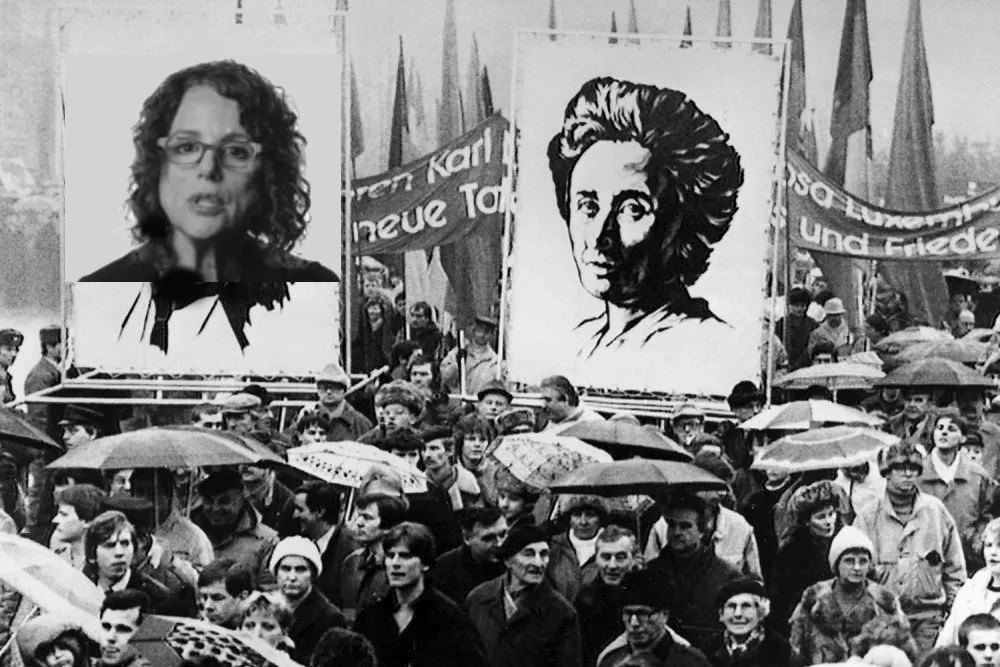
Two thousand years later, for the Spartacus League to persuade people in Berlin to take part in a desperate uprising against the men responsible for world war one, required more than Marxist theory.
There are food riots in Venice, in Lisbon, Moscow, Singapore. There is plague in Russia, and misery and despair everywhere. Violated, dishonoured, wading in blood, dripping filth — there stands bourgeois society.
– Rosa Luxemburg, The Junius Pamphlet, April 1919
Her skill at defending the theory helped, but the clincher was the fact that what she said was true.
Critical Theory in general is concerned with various identities such as race and sex. CRT concentrates on the race aspect. Marxism is about the relationships between economic classes, and their members’ consciousness of these relationships; this is not identity politics. Luxemburg didn’t introduce herself by saying “speaking as a disabled Jewish middle-class white woman.”
Another way of illustrating the difference between CRT and Marxism is to contrast what CRT claims about the relationship between white people and others, with an example of the actual social relationship identified by Marxism. In White Fragility, June 26th 2018, Robin DiAngelo says that white people need “people of color” in order to define their whiteness. The CEO of Amazon needs people working in the company’s warehouses, but neither he nor I need anyone to be of any particular race. DiAngelo’s claim is without merit; it is simply a projection of her psychological issues. Marxism is completely different. A corporation cannot make a profit unless what its employees produce is worth more than they are paid. This is mathematics, not morality.
Conflict theories in conflict
In summary, I enumerate some of the correspondences and conflicts between CRT and Marxism.
The correspondences are easy to list. To paraphrase Rufo:
society is divided into oppressors and oppressed
there is conflict between them
radical change is needed.
The differences are more numerous — the following are a few of the most obvious.
The 1619 Project, begun on August 14th 2019 by the New York Times Magazine, is currently being force-fed to children in schools across America. It is clearly an expression of CRT, consisting of a series of articles arguing that anti-black racism is an essential component of the nature of the republic. Historian Sean Wilentz pointed out some of the egregious errors in the Times’ claims, in a lecture on November 4th 2109. The World Socialist Website’s offensive began twenty-four days later, with a series of interviews with several expert historians, highly critical of the Project, and on March 11, 2020, the Times changed the phrase
one of the primary reasons the colonists decided to declare their independence from Britain was because they wanted to protect the institution of slavery
by inserting “some of” before “the colonists”, which effectively abandons the purpose of the Project, while dialectically preserving it. See 1620: A Critical Response to the 1619 Project, Peter Wood, November 17th 2020.
Some conservative critics of the Project simply ignored these inconvenient Marxists. One exception is historian Phillip W Magness, who is piqued that they published their critique before his (The 1619 Project: a Critique, April 7th 2020, page 102). Another is Charles C W Cooke, a senior writer at the National Review, who is more generous:
Well, I can’t say I expected it to be the International Committee of the Fourth International that most effectively ripped the New York Times‘s “1619 Project” apart, but here we are.
The latest fashionable nonsense from American academia is known as “Critical Race Theory,” henceforth, “CRT.” It alleges that the Anglo-Saxon nations are saturated with “systemic racism,” and that their white inhabitants benefit from it — they have “white privilege.” Its method of teaching includes treating people differently according to their race. When teachers started using it to abuse schoolchildren, a fightback began. The best source of information about this fightback is Christopher Rufo’s website, christopherrufo.com.
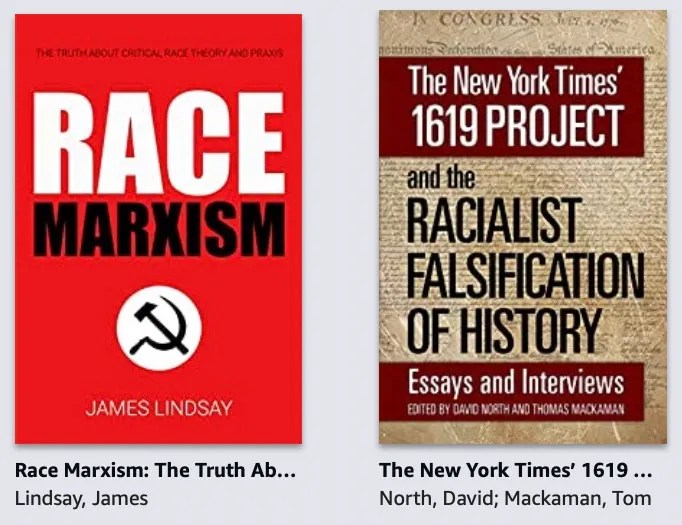
Two critiques of CRT have been published recently. One of them, James Lindsay’s Race Marxism, claims that CRT is an expression of Marxism. The Amazon page for the book says
The evidence of this claim is so overwhelming upon even casual examination that it is a shock that it isn’t immediately plain to everyone who encounters it,
and Lindsay repeats this confident assertion several times in the text.
The other one, by the International Committee of the Fourth International, claims CRT is completely antithetical to Marxism, and leans on the latter methodology in its demolition of one of CRT’s recent expressions. It’s called The New York Times’ 1619 Project: a Racialist Falsification of History.
They can’t both be right.
I probably need to say at the outset that, though I find the Marxist critique to be better than Lindsay’s, I am not defending Marxism per se. In labelling itself “the Fourth International,” the Committee identifies with the Trotskyist tradition. Leon Trotsky didn’t murder as many people as Josef Stalin, but that’s only because he was kicked out of the Soviet Union in 1929.
My aim is simply to show that Lindsay is wrong — CRT is not a branch of Marxism. It’s important to get it right, because the fightback requires bringing on board as diverse a collection of people as possible. The International Committee realised this, and interviewed leading historians of the American Revolution, slavery and the Civil War, most of them not Marxists. Some conservative critics of CRT also realise this, and give credit to the Committee:
Well, I can’t say I expected it to be the International Committee of the Fourth International that most effectively ripped the New York Times’s ‘1619 Project’ apart, but here we are.
— Historians vs. the ‘1619 Project’, Charles CW Cooke, National Review, December 2nd 2019
Likewise, the National Association of Scholars reprinted an essay by Trotskyist Tom Mackaman on February 22nd 2022:
The 1619 Project is currently being force-fed to thousands of schoolchildren around the country. There are several other rebuttals of the Project in print, but A Racialist Falsification is the most comprehensive.
Lindsay does not justify his claim that CRT, and its parent ideology, Critical Theory, is “Marxist,” “Marxian,” or “neo-Marxist” with quotes from Marx or Engels. You might assume, in a book whose title includes the word “Marxism,” it would include many references to the works of Karl Marx.
An exception is on page 223, where Lindsay quotes Marx’s Introduction to Capital, in order to show his connection to G.W.F. Hegel. This is the beginning of an introduction to the German philosopher’s ideas, which is said to explain a number of phenomena, from mass murder under Stalin and Mao, to Nazi pseudoscience and the neoconservatives, who after all are “former Trotskyites” — page 227. But Lindsay seems unaware that there are faithful Trotskyites who have avoided the ideological traps laid by Hegel.
Race Marxism came out on February 15th 2022. The essays and interviews which are now collected in A Racialist Falsification began to be posted on the World Socialist Website on November 24th 2019. There is no evidence in Race Marxism that Lindsay has looked at them, though he refers to the 1619 Project as an expression of CRT several times.
Lindsay called his work “Race Marxism” in the belief that Marxism is a “conflict theory,” and that if you substitute one conflict for another — race for class — it’s still a type of Marxism. Apart from the obvious logical error in claiming that, if two theories have something in common, one is an expression of the other, there is also the question of how much truth there is in either theory.
Critical race theorist Robin DiAngelo wrote, in 2018, in her bestseller White Fragility, that white people need “people of color” in order to define their “whiteness.” Marxists believe the CEO of Amazon needs people working in the company’s warehouses, but he doesn’t need them to be of any particular race. A corporation cannot make a profit unless what its employees produce is worth more than they are paid. This is simple mathematics. Lindsay never deals with this argument, instead putting Marxist phrases like “exploitation,” “surplus value,” and “alienation” in quotes, as if they are so obviously ridiculous he doesn’t need to explain why — see, for example, page 299.
The phrase “false consciousness” occurs seventeen times in Lindsay’s 357 pages. It occurs just once in the collected works of Marx and Engels, in a throwaway remark in a letter written by Engels in 1893.
Lindsay uses the term “conspiracy theory” to describe ideas he disagrees with, without saying what’s wrong per se about a conspiracy theory, and he uses it to describe ideas which have nothing conspiratorial in them. For example, he says on page 35, that CRT analyses race in the same way Marxism analyses class, “with a view to the ‘capitalist superstructure’ that’s upheld by ‘bourgeois values’ (i.e., a vast conspiracy theory).”
Though he uses quotation marks, he doesn’t say where he gets the quotations from. Neither does he say why the process Marxism allegedly describes is in any way conspiratorial. Marx wrote, in The German Ideology, 1845,
The ideas of the ruling class are in every epoch the ruling ideas, i.e. the class which is the ruling material force of society, is at the same time its ruling intellectual force… The ruling ideas are nothing more than the ideal expression of the dominant material relationships, the dominant material relationships grasped as ideas; hence of the relationships which make the one class the ruling one, therefore, the ideas of its dominance.
I don’t believe this is correct — but this isn’t a review of the works of Marx.
Lindsay’s treatment of other communists, such as Antonio Gramsci, is similarly sloppy. He lists Selections from the Prison Notebooks in his references, but his claim that he “spread much of the soil in which Critical Race Theory later germinated” is not backed up by citations. Gramsci’s career was not about infiltrating religion, family, education, media and the law, and “changing those key institutions from within”, as Lindsay alleges on pages 110, 117, 125, and 188.
In Chapter 3, Lindsay describes the Frankfurt School as “neo-Marxist.” But after the School relocated to America, its work eschewed the materialist conception of history. It owed far more to Freudian psychoanalysis — in their influential work The Authoritarian Personality, these refugees from Nazism used unfalsifiable pseudoscience to paint normal American families as psychologically disturbed, and prone to raising “fascists.” Lindsay’s own quotes from the Frankfurters show that they had broken with Marxism. If there is one central plank of Marxist theory, it is the irreconcilable conflict between the interests of the bourgeoisie and those of the proletariat. Lindsay quotes Frankfurt scholar Herbert Marcuse at length to the effect that the workers have been bought off, and are no longer revolutionary, so someone else has to take their place. But a theory which substitutes minorities for the proletariat is not Marxist, any more than a theory which puts race in place of class.
Contrast this with how the International Committee analyses the role of CRT, from a Marxist starting point. From page 292 onward, they claim that CRT is part of “identity politics”, which is used by the Democratic Party to divide the workers by race, etc.. Nothing could be further from Marx’s “workers of the world, unite”.
The Trotskyists have a “dialectical” approach to history, where, for example, the American Revolution is progressive, but insufficient. They reiterate Marx’s cheerleading for Lincoln in the Civil War. But even if you don’t agree with any of this, the Committee’s interviews with scholars constitute irrefutable evidence that the 1619 Project is an attempt to mislead Americans about their country’s history.
The Committee’s writers are not surprised that big corporations such as Bank of America have enthusiastically adopted CRT; they think it’s in their “material interests”. This sounds to me more sensible than Lindsay’s claim that they have adopted a variant of Marxism.
Frankly, I find it hard to understand what happened to James Lindsay. His previous work, with Helen Pluckrose, Cynical Theories, is required reading for anyone who wants to understand the intellectual roots of CRT, backed with citations and references. Race Marxism is simply preaching to the choir, since the only people who will believe it have already made their minds up.
The woke elite, in academia, the media, government, and the personnel departments of various companies tell us, in effect, that Western people and societies are uniquely, ubiquitously, and pathologically ethnocentric. It is my contention that nothing could be further from the truth.
Introduction — Antiracism in Higher Education — Antiracism’s Claims are the Opposite of the Truth — Why So Much Credulity Toward Antiracism? — Negative Consequences of Antiracism in Britain — Conservative Uses of Antiracism — Definitions — Acknowledgements — References
Introduction
Some of the concepts discussed below have contested labels. For example, defenders of Critical Race Theory claim that its critics don’t know what it means.
I put my definitions, what I mean when I use particular words, under a subheading near the end of the essay.
Briefly, I use the terms “Wokeness,” and “Critical Social Justice,” to mean the broad range of left-wing views and practices which have spread into the commanding heights of many institutions of the Western world in the last few years. “Antiracism” and “Critical Race Theory” are more specific terms, covering the idea that white Western people need educating to overcome their ethnocentrism. Examples of these claims can be found in the bestselling books of Ibram X Kendi and Robin DiAngelo, and in the New York Times’ 1619 Project. I also call this idea “Woke Racism,” after an article in the National Review by Frederick M Hess, Lone Whistleblower Takes On the Woke Racists at Smith College.
The origins of these ideas can be found in US and Canadian higher education.
Antiracism in Higher Education
Consider a college campus boiling with racial and gender sensitivity, with courses in victimization, organizations for victims, a constant barrage of victimization propaganda — but no immediate and palpable victims. ‘Anti-racist’ vigilantes with no racists (or misogynists and homophobes) to hang had better get busy and make some, and as we see, they often do.
In March 2006, in, Durham, North Carolina, the district attorney prosecuted three white students, following the claim of a black woman that they had raped her, ignoring clear evidence that it was false. Their college president said the alleged rape was an example of “racism”, and eighty-eight professors signed a “Listening Statement”, defending the woman’s allegation. Eduardo Bonilla-Silva is one of them. After the students were acquitted, and the DA imprisoned, he doubled down. His book Racism Without Racists, currently in its 5th edition, claims
Shielded by color blindness whites can express resentment toward minorities; criticize their morality, values and work ethic; and even claim to be the victims of ‘reverse racism’.
Jodi Shaw doesn’t claim to be a victim of reverse racism. She says “it’s not, it’s very simply racism”. In July 2018, at Smith College, Northampton Massachusetts, a black student falsely accused white employees of racial profiling. Even after the hoax was exposed, the college president continued to act as if white racism was a problem, and her solution was to subject her white subordinates to actual racial profiling, driving one of them, Jodi Shaw, to resign and go public — Lone Whistleblower Takes On the Woke Racists at Smith College (ibid.). President Kathleen McCartney’s explanation of her policy was “it is impossible to rule out the potential role of implicit racial bias”.
Indeed: the claims of antiracism cannot be falsified. Robin DiAngelo’s White Fragility argues that if you’re white, and you don’t acknowledge your racism, you have something wrong with you which needs fixing. Her theory is unfalsifiable; it implies that anything which attempts to show it is flawed, including this sentence, is an example of the problem it pretends to identify.
Critical Race Theory (CRT), a variant of antiracism, originated at Harvard. Invented by professor Derrick Bell and developed by Kimberlé Crenshaw, and others, it is a subset of Critical Social Justice, an idea originating in the Frankfurt School. There is not enough room in this essay to give these schools the treatment they deserve — those interested could start by consulting Cynical Theories, by James Lindsay and Helen Pluckrose.
Approximately ten years ago, I began to become aware of the exaggeration of racially-motivated crimes in America. I created the website fakehatecrimes.org, which new users can join, and add alleged hate crimes which are likely, or proven, to be fake. It extends the 1990s research of Laird Wilcox (ibid.). Some of this data was used by professor Wilfred Reilly, in his February 2019 book Hate Crime Hoax. The site currently contains hundreds of cases, most of them in US colleges and universities, in which activists invented, or perpetrated against themselves, crimes allegedly motivated by bigotry.
Antiracism’s Claims are the Opposite of the Truth
The woke elite, in academia, the media, government, and the personnel departments of various companies tell us, in effect, that Western people and societies are uniquely, ubiquitously, and pathologically ethnocentric. It is my contention that nothing could be further from the truth. First, I will give a list of examples which show Western societies are not particularly racist, then, give examples of credulity toward the allegations of antiracists, then try to explain it. Consider
– The two most effective forces fighting to abolish slavery during the 19th century: the Royal Navy and the US Army – Protests against racism from the 1930s onward – The defeat of Nazi Germany – Subsequent support for national and international institutions committed to opposing racism – The Civil Rights movement – Civil rights legislation – Affirmative action to give black students an advantage in applying for places at US universities
Contrasting modern Western societies with others gives the lie to the claim that the West is particularly racist.
In May 2013, the Washington Post published a map of “racial tolerance,”based on research by two Swedish economists, classifying areas of the world according to percentage of inhabitants who would not want to live next to people of a different race. Blue is the most tolerant; red, the least. The tolerant, dark blue areas are the Anglo-Saxon countries, and most of South America. India is bright red. It appears that, on average, Indians are remarkably intolerant of people they consider members of a different race.
A recent paper from Cambridge University Press, Genetics, Anthropology, and the Politics of Racial Nationalism in China, describes the corruption of human origins research in the interests of Chinese racial mythology. Frank Dikötter’s 2015 book The Discourse of Race in Modern China shows that the People’s Republic of China is more racist than the West, although he follows Richard Lewontin and Stephen Gould in denying that races exist. If this were true, the Chinese government claim that Mongols, Uyghurs and Tibetans are part of the same race as the Han, would be neither true nor false. But in fact, it is false. Uyghurs are more closely related to other Turkic-speaking peoples than to the Han Chinese people. This is important, because Chinese claims have consequences — they underpin the destruction of minority cultures.
Eastern Europe is the only area where the football authorities are still punishing clubs for racist chanting from their fans. English players wear “No Room For Racism” armbands, and various other subtle hints are directed at fans, implying that they need educating. As Brendan O’Neill shows, this is unjustified.
Westerners are remarkably open to the claim that they are racist. Note
– The spread of antiracism training in Western institutions – Widespread acceptance of the “unmarked graves” hoax, which claims hundreds of native children in Canadian residential homes were murdered and secretly buried – The leading science journal Nature has adopted a policy where scientific conclusions can be dropped if they clash with the demands of antiracism — The Fall of Nature, Bo Winegard – The term “white supremacy” is often used in the media, and by politicians, without evidence, to describe people they disagree with — When, in January 2019, in Washington DC, a group of black adults subjected a group of white schoolboys to racist abuse, the media, for the most part, claimed it was the boys who are racist — President Biden called Kyle Rittenhouse a white supremacist, after he shot three white men who were attacking him in Kenosha Wisconsin, during – The protests and riots of 2020
The 2020 protests for “racial justice” were sparked by the murder, on May 25, of African-American George Floyd, by white policeman Derek Chauvin. Although no evidence of a racial motive for that crime has been produced, large numbers of white people acted as if there was, and some of them acted as if they believe they are responsible for it. I was about to join one of the protests, when I saw signs saying “white silence is violence,” which means, if you’re white, and you don’t proactively agree with antiracism, you are committing violence, so violence can justifiably be used against you.
It is true that black people are disproportionately targeted by the police in America. But adjusting for the black rate of crime debunks the claim of racial discrimination. 0.8% of whites commit violent crimes, but for blacks, the ratio is more than twice as high (Criminal Victimization, 2018, US Department of Justice, Table 12).
Given the evidence that Western societies, particularly the English-speaking ones, are institutionally less racist than most others, we can conclude that antiracists are deluded, or dishonest. There is no need to examine their motives any further. But we need to try to understand the weakness in these societies which enables the remarkable success of woke racism.
Why So Much Credulity Toward Antiracism?
A complex theory, constructed by Kevin MacDonald, an evolutionary psychologist, claims that the specific material conditions of ancient northwestern Europe selected for certain genetic psychological traits, which, today, are maladaptive — “pathological altruism,” or white guilt.
Another theory, in a work by Benedict Beckeld, locates Western self-contempt — oikophobia — in the inevitable trajectory of civilisations rising and falling, with emphasis on the particular examples of ancient Greece and Rome, and modern Britain, France and the USA. On pages 57–58, Beckeld more or less admits that oikophobia is almost exclusively Western.
I am unable to decide how much truth there is in either theory. I don’t know the cause of Western weakness in the face of wokeness. Currently, I can only ask readers to patiently and politely point out what’s wrong with it, and support the brave people refusing to accept the racism of antiracism. For instance, one can donate to Jodi Shaw’s legal costs in her case against Smith College. Her GoFundMe page is help-jodi-stand-up-to-smith-college.
Oikophobia, or whatever it is, is deep-rooted. Even some of the people most effective at exposing the harmful consequences of antiracism resist drawing logical conclusions from their findings.
Jayne Senior is the whistleblower who exposed the Pakistani-origin child-rape gangs of Rotherham, and the role of the Labour party in helping them avoid prosecution. In her book Broken and Betrayed, she writes
Of course there was a grooming problem in Rotherham involving Asian men and white girls — you’d have to be blind not to see that — but there was no way I was going to contribute to any political point-scoring on behalf of the BNP or the EDL.
(Broken and Betrayed, page 230). Instead, in chapter 21, from page 321 onwards, she describes her integration into the South Yorkshire Labour machine.
The word “Islam” occurs twice in Broken and Betrayed, “Muslim” six times, and “Asian” sixty-seven. In the UK, “Asians” usually means people from the Indian subcontinent and their descendants. “Asian grooming gangs” is a phrase used to broaden the scope and fudge the issue. Over 80% of convicted gang members have Muslim names, and hardly any have non-Muslim Indian names.
Ayaan Hirsi Ali has written extensively on the negative consequences of Islam for women and girls. She herself was a victim as a child in her native Somalia, and her subsequent campaigns in the Netherlands and the USA have necessitated 24-hour security to protect her from Muslims who want to murder her. Her 2021 book Prey: Immigration, Islam, and the Erosion of Women’s Rights explains how, after decades of advances, areas of European countries are becoming less comfortable for women, because of the presence of growing numbers of men from Muslim cultures. But, like Jayne Senior, she has a fear of supporting what she calls “right-wing populism.”
Only by clarifying what has gone wrong in Europe in recent years can one make a truly credible case for effective integration of immigrants. For that — not the exclusion and repatriation favored by the populists of the Right — is the only feasible way forward.
(Prey, page xiv). Both of the above quotations make something sound worse, by juxtaposing it with something which really is worse. Senior lists the British National Party and the English Defence League together, although they are quite different. The BNP was racist, whereas the EDL aimed at an ideology — Islam. Ali puts “exclusion” and “repatriation” together. “Repatriation” of non-white citizens, as advocated by the BNP, would be a crime against humanity. “Exclusion” is another matter. Nation states, by definition, include some people and exclude others. It would be “feasible” for some of them to exclude potential immigrants from a specific culture. Her book is full of examples of immigrants who don’t want to be “effectively integrated,” but she doesn’t explain how to deal with this problem.
Negative Consequences of Antiracism in Britain
Antiracist ideology landed in the United Kingdom at least thirty years ago. It influenced the 1993 Macpherson inquiry into the police investigation of the murder of a black London teenager, Stephen Lawrence, and the 2000 Race Relations (Amendment) Act. (See Sir William Macpherson: a divisive legacy, Adrian Hart, Spiked Online, March 8, 2021). Macpherson’s definition of a racist incident was “any incident perceived to be racist by the victim or any other person.” This phrase, which shifts the burden of proof from the shoulders of the accuser to those of the accused, originates in Critical Race Theory. “Listen first to the voice of the victims” urged American academic Mari Matsuda, in the collection of essays Words That Wound.
Her phrase is triply misleading. Firstly, anyone investigating an allegation inevitably “listens first” to the accuser, but then they must listen to the accused, assuming his innocence unless and until he is proven guilty. In CRT, “listen” means “believe,” because, secondly, the phrase “the victims” assumes the guilt of the accused — in should be “the alleged victims.” Thirdly, antiracism does not encourage listening to all victims’ voices. Witness the “grooming gang” scandal.
Following the publication of Macpherson’s report, antiracism spread around the country. It was not the only cause of the grooming gang scandal, but it contributed to the authorities’ failure to keep sexual offenders away from vulnerable minors. Some of them prioritised combatting white racism over protecting underage white girls from Pakistani gangs.
To cite just one example, Jayne Senior, the Rotherham whistleblower, describes a white man telling the police a gang was “grooming” his 14-year-old daughter. They ignored him, until he shouted a racist word at the men’s house. Then the police quickly appeared, and found the girl getting out of bed with a man, but they did not arrest him — instead, they charged father and daughter with disorderly behaviour.
Jessica subsequently told me that when she was driving around with her abuser in his flashy car, he’d often play the ‘race card’ if stopped by the police.
After the story broke, the government appointed professor Alexis Jay to control the damage. Her report was completed in August 2014.
Several staff described their nervousness about identifying the ethnic origins of perpetrators for fear of being thought racist; others remembered clear direction from their managers not to do so.
In his 2018 book The Tribe: The Liberal-Left and the System of Diversity, Ben Cobley explains how the Labour party’s embrace of “identity politics” enabled the “race card” described by Jayne Senior above. Each sector was expected to stay in its lane. Muslim “community leaders” were trusted to look after their own. Feminists concentrated on getting all-female shortlists for election candidates, and kept quiet about the grooming gangs.
Antiracist activists and journalists sometimes help the grooming gangs, by labelling whistleblowers “racist.” An article by Libby Brooks in the Guardian, January 6, 2011 says “claims about Muslim men grooming white girls” is an example of “racialising crime.” This is doubly false; firstly, the claims are true, and secondly, Islam is not a race. Nevertheless, fear of being accused of racism helped delay the exposure and prosecution of the gang members, as Jayne Senior and Alexis Jay make clear.
Conservative Uses of Antiracism
One of the techniques used by antiracists is to persuade listeners to accept the substitution of feelings for facts, so that an argument can be dismissed by claiming that it offends, or “harms,” somebody. Another is to pretend disagreement with an ideology is prejudice against a section of the population. For example, liberal lawyer Maud Maron refused to pretend to agree with aspects of antiracism, and was driven out of her job by left-wing activists who wrote that she “is racist, and openly so” — The Courage of Maud Maron, The American Conservative, July 27, 2021.
Conservatives can also use these techniques. In 2019, an event entitled “Not Backing Down: Israel, Free Speech and the Battle for Palestinian Human Rights” took place at the University of Massachusetts. The College Fix, a conservative student-produced online magazine, published an articlequoting Jewish students claiming they “will suffer immediate and irreparable harm” from this conference.
In March 2019, representative Ilhan Omar claimed, on Twitter, that the Israel Lobby is wealthy: “It’s all about the Benjamins baby”. The response of her critics was to say that this is a “trope.” Little effort was made to show that her claim was factually incorrect, but she apologised, using the woke language customary in the Democratic party, and deleted the tweet. However, there is some truth in her original claim — the American Israel Public Affairs Committee spends millions trying to get the most pro-Israel candidates selected for elections. Here is one example — Summer Lee Faces AIPAC Spending Onslaught In Final Days Of Pennsylvania Primary, The Intercept, May 2022. Another article, in the Guardian, August 2022, claims “Aipac has poured more than $24m into defeating Democratic primary candidates critical of Israel”.
The Anti-Defamation League uses these antiracist techniques, both to exaggerate the danger from right-wing extremists, for example, The Proud Boys, and to smear left-wing critics of Israel as racist.
Wokeness — the traditional left emphasises economic class as the most important division in humanity. Its leading theorist was Karl Marx. The woke left theorises that other divisions — race, gender, sexual orientation, and so on — matter more. “Critical Social Justice” is a term preferred by the defenders of wokeness, as it conveys an impression of intellectual rigour and moral virtue.
Critical Race Theory — a theory formulated by Harvard Law School professor Derrick Bell in the late 1970s and further developed by Kimberlé Crenshaw. Bell and Crenshaw argued that the Civil Rights Movement had failed to reform American society in any fundamental way and that all American institutions are systemically racist.
Race — DNA sampling reveals humanity is divided into large clusters of related people, with sparsely populated gaps between them (Charles Murray, Human Diversity). How large a cluster has to be, and how great and sparse the gaps between it and other clusters, for it to be called a “race,” is debatable. This does not mean that race is a meaningless concept; the clusters exist.
Racism — inaccurate and negative beliefs about the members of a race, discrimination or violence against the members of a race, or belief in the superiority of one race over others. Although race is real, racism can also attribute imaginary characteristics to imaginary races. The National Socialists’ beliefs about Aryan, Slavic and Jewish races were racist, regardless of whether or not these races exist.
Antiracism — antiracism, without a hyphen, is a term adopted from the work of Ibram X Kendi. It includes the works of Critical Race Theory and The 1619 Project, begun on August 14th 2019 by the New York Times Magazine, currently being taught to thousands of schoolchildren. Antiracism implicitly makes the racist claim that white Europeans are uniquely racist. It uses Kafkaesque circular reasoning to claim that the denial of racism, by white people, is evidence of racism.
Acknowledgements
Of the individuals and organisations which provided me with the evidence which led to this essay, I would like to mention first the Freethinkers of Portland State University, who are taking a brave stand in the lions’ den. The National Association of Scholars has produced a series of papers which informed some of the arguments within. Christopher Rufo has accumulated the most convincing evidence of the spread of Critical Social Justice in American government, corporations, universities, colleges and schools. The website Spiked Online, podcasts including Katie Herzog’s, Bari Weiss’s, and Ayaan Hirsi Ali’s, and several college-based online magazines, such as Minding the Campus, have all helped. Finally, and perhaps surprisingly, the World Socialist Website has produced the most comprehensive demolition of the New York Times’ 1619 Project. None of these sources are responsible for anything I argue herein.
‘Social Justice’ is a collection of ideas originating in North American academia. I wish to contribute to the effort to defend my society against it.
Andrew Doyle’s book, The New Puritans, September 2022, is a recent rigorous critical analysis of this phenomenon.
Social Justice activists exaggerate the degree of bigotry in modern Western countries. This is especially worrying for members of minorities. They have divided students, including children, by race. They have driven people who failed to use woke language out of their jobs. They screen candidates for academic positions in the humanities and social science, and, increasingly, in science, for contributions to social justice. For a mountain of evidence for this assertion, read Ideological Intensification: A Quantitative Study of Diversity, Equity, and Inclusion in STEM Subjects at American Universities, Mason Goad and Bruce R Chartwell, November, 2022:
If we want to debunk Social Justice, we need to follow some simple rules. For example, don’t repeat a historical claim you found on the internet, without giving a source.
Christopher Rufo is an important figure in the fightback. This is a quote from his speech at Hillsdale College, April 2022:
“This idea is traceable to Italian communist Antonio Gramsci, who wrote in the 1930s of ‘capturing the culture via infiltration of schools, universities, churches, and the media by transforming the consciousness of society.’”
I searched Google and Google Scholar for the phrase, and sections of it, in English and Italian; for example, “catturare la cultura,” “coscienza della società.”
There were over twenty results. Some of them do not contain anything resembling the phrase. Those which do, either have no source, or refer to each other. The exception is a book by conspiracy theorist William Borst. He claims Gramsci wrote it in the magazine Ordine Nuovo. He doesn’t give a date, but the magazine published its final edition in 1925, not the 1930s, as Rufo said.
I consulted an Italian friend to see if he could track down the quotation. He could not; he said, “it’s probably made up.” I ploughed through the entirety of the English version of Gramsci’s works. I could not find anything like “capturing the culture” or “transforming the consciousness.”
Rufo is referenced by a growing number of articles. One example is this article in the March 6th 2023 edition of the National Review, The Long March Back, Antonio Gramsci And Us, by Nate Hochman:
It claims that Rufo “routinely cites” Gramsci, but gives no original source for his citations.
Rufo has said that he has relatives in Italy who are familiar with Gramsci’s work. I refer to his interview on the Ayaan Hirsi Ali podcast, in June 2021. If his quote exists, surely he could have found the source for it.
James Lindsay is another prominent critic of Social Justice. He is the author of the book Race Marxism, March 2022. The phrase ‘false consciousness’ occurs seventeen times. He gives the impression that it is a central Marxist concept. I found it once in the collected works of Marx and Engels, in a throwaway remark in a letter written by Engels. It’s easy to find numerous similar errors in Lindsay’s work.
Social Justice academics could use these questionable claims to discredit their critics. To avoid this, we need to follow the rules, such as ‘give sources for citations’.
One of the consequences of the Hamas attack of October 7th, 2023, has been the wholesale conversion of conservative critics of ‘cancel culture’ into its most enthusiastic advocates.
Up until that event, a cluster of online activists attracted millions of followers and subscribers opposing the excesses of what has come to be called ‘Woke.’ Bari Weiss is a good example. She has defended victims of Woke, including a Palestinian family:
Woke activists encourage doxxing, censorship, and firing, of people with whom they disagree. Examples from the last few years are legion. One can google, for example, ‘Jodi Shaw,’ ‘Colin Wright,’ and ‘Roland Fryer.’ People have been cancelled for questioning whether the police are racist, and claiming that sex is binary.
In the article Woke Racism and Western Weakness, September 2022, I mentioned conservatives using similar language to the Woke left, in response to a conference entitled “Not Backing Down: Israel, Free Speech and the Battle for Palestinian Human Rights.” They said some Jewish students claimed they “will suffer immediate and irreparable harm” from this conference, and tried to get it cancelled:
Since October 7th, the Woke wave of cancel culture has been dwarfed by a conservative tsunami. KC Johnson is a leading archivist of false allegations of racism on campus. But today, he supports banning pro-Palestinian student groups, because he claims they are antisemitic: https://x.com/kcjohnson9/status/1723159740904018078.
Without missing a beat, influential conservative intellectuals, on both sides of the Atlantic, such as Megyn Kelly, and Douglas Murray, went full cancel-culture. They falsely claim that protests calling for a ceasefire to save the lives of Palestinian children are pro-terrorism. They say that Jews are scared, ignoring evidence of the sizeable Jewish presence at these protests.
False accusations of racism, claiming that a minority is frightened, the belief that words are violence — these are the techniques the Woke left has used against conservatives, or even biologists, in higher education, but also in government, corporations, and the media. Conservatives are now trying to intimidate critics of Israel using the same techniques.
The journalist Glenn Greenwald, a consistent opponent of assaults on freedom, wherever they come from, has chronicled numerous examples of conservative cancel culture on his System Update podcast: https://rumble.com/c/GGreenwald.
Conservatives not only claim that defending Palestinian human rights is pro-Hamas, they claim it is a consequence of Woke leftist ideology on campus. But the resistance of the Palestinians predates both. It started when Jewish militias ethnically-cleansed most of the Palestinians, directly after world war two.
Conservative cancel culture is more similar to Woke cancel culture than the defence of Palestinians is to either. The Western countries, particularly America, back Israel to the hilt. Those trying to suppress critical voices are complicit in mass murder.
Censorship, Fake Hate Crimes, and the Israel Lobby
A 2008 pamphlet arguing that support for the genocidal ideology of Zionism is related to the Allied narrative of WWII
Originally, this was a printed pamphlet, and a series of pages on the website pacificaforum.org. Herein, I’ve recreated it as one article.
Anti-fascists celebrate the bombing of Dresden
To Preman, who first pointed me in the right direction
No copyright – this pamphlet may be reproduced in full by anyone
What is Anti-Fascism?
The phrase ‘anti-fascism’ suggests opposition to fascism. If that were all there was to it, it wouldn’t be worth writing about. Almost everyone who has heard of fascism is opposed to it. It is known as one of the main causes of World War II and the concentration camps in which millions died.
But anti-fascism has always meant more than simply opposition to fascism.
Before World War II, anti-fascism was the slogan which recruited people across Europe and America to travel to Spain to oppose General Franco’s coup against the left-wing government. It was clear even at the time to a small group of ultra-leftists in France and Italy that it was a mistake to volunteer for this apparently noble cause. Their critique sounds kind of retro today, but with the benefit of hindsight, it is obvious that they were right. Today, we can see that those who volunteered for the ‘International Brigades’ under a coalition of anarchist and communist leaders fought and died for a cause that was not only doomed, but worse than useless, even if it had succeeded.
Homage to Catalonia by George Orwell and Ernest Hemingway’s For Whom the Bell Tolls are great novels about the Spanish Civil War. They are also accurate accounts of how the Communist Party, controlled by the Soviet Union, used the volunteers as cannon-fodder, then murdered its political rivals within the left-wing coalition or abandoned them to the right-wing forces they were fighting.
So Franco won, massacred his opponents, and established a military dictatorship which kept Spain in the middle ages for forty years. What is uncontested is that he refused to enter Spain into World War II on the side of Hitler, who respected Spain’s neutrality. Had the left won the Spanish Civil War, the government would have been a puppet of Moscow. Spain would probably have been forced to enter the war on the side of the Allies, and many more Spaniards would have died.
The extent to which people were inspired by anti-fascism during World War II can be exaggerated. For example, most of the Russian soldiers fighting the Germans at Stalingrad weren’t motivated by left-wing propaganda; they were marched to the front at gunpoint. But after the war, anti-fascism was found to be useful to the victors, and given a new lease of life. During the Nuremberg trials of the Nazi leaders, if any crime could be attributed to the Allies, the USA and the Soviet Union, as well as to the Axis powers, the charge was dropped. Thus air force commander Göring was not tried for bombing cities, nor admiral Dönitz for sinking civilian ships, since the Allies committed both these war crimes too. Göring was sentenced to death for his minor role in the Holocaust, though his bombing campaigns were by far his greatest crimes.
Each country had its specific contribution to make to the war effort – the Americans had their atom bombs, the Russians liked their rape, and the Germans’ specialty was genocide. In practice, the German Holocaust was little different from what the Allies were doing at the same time: the German government murdered many innocent civilians from Germany and neighboring countries using poison gas and other methods, and the Allies did the same thing using bombs. But British schoolchildren are taken on trips to see the ruins of Belsen, but not Dresden. This one-sided interpretation of history is enforced by law in Germany and Austria. Anti-fascism has become a central pillar of the official version of history under whose influence we have all been raised. When an Australian historian was arrested in London recently for holocaust denial, it was not for denying the genocide of the Tasmanian aborigines.
Why anti-fascism, rather than anti-communism or anti-democracy? No-one actually argues that bombing people is less barbaric than gassing them, yet that is what, implicitly, we are being told when we are taught to hate Hitler but to respect Roosevelt. This is anti-fascism – not just opposition to one set of war criminals, but support for the other set. Anti-fascists cannot claim to be opposed to both sides – why would they call themselves ‘anti-fascists’ if they do not believe fascism is worse than other forms of civilization, if they do not believe that gassing Jews is worse than burning Germans to death? This immediately raises the worst aspect of anti-fascism. The phrase we have all learned, ‘The Holocaust’, means the attempted genocide of the Jews, excluding other holocausts, excluding other categories whom the Nazis attempted to wipe out, and excluding the equally monstrous crimes of the Allies. Anti-fascism discriminates in favor of Jews.
This hypocritical, self-righteous, discriminatory, racist perspective also supports vigilance (and often violence) against individuals and small groups of alleged fascists in the world today. It means exaggerating their importance, and blaming them for ‘hate crimes’, many of which turn out to be fake. We are urged to be on guard against the non-existent threat of the emergence of a major racist movement. When a lone lunatic commits a crime against a minority person, the media make out its a movement. And the reason the media exaggerate the threat of hate crimes is because it sells, and it sells because we believe – we, with our selective moral attitudes, keep anti-fascism alive:
The US media ran a series of stories about ‘black churches’ being burned down by racists. It turned out that kids were setting fire to churches at random, indifferent to the buildings’ ethnicity.
French Jews faked an anti-semitic attack by Muslims on the Metro – the media devoted a lot more space to the alleged attack than to the subsequent police announcement that it was made up
A black woman in Oregon put a burning cross in her own front yard to try to claim she was a victim of racists
Jews in London invented cases of racial harassment
A black man was injured in a fight in an Oregon town. He told police nothing racist was said – it just happened that the other participants were white. Despite this clarification, local anti-fascists continue to use it as an example of a ‘hate crime’ in their efforts to suppress freedom of speech.
A black teenager in New York claimed she suffered a horrific assault by a group of white men including the assistant district attorney. After an emotional campaign on her behalf by black politicians, she was found to have invented the incident in its entirety.
A Jewish couple in Oregon set fire to their own apartment and scratched swastikas on their car and claimed it was a hate crime
Another black woman, in North Carolina, claimed to have been raped by several white students from an Ivy League university. Despite obvious inconsistencies in her story, the police proceeded. The students were subjected to trial by media, but in the end, she was proven to be lying.
I could go on. In fact, I will. Where hate crimes are not simply invented, they are often exaggerated. A California woman was convicted of the capital crime of murder because her dog went berserk and killed another woman. The woman was criminally irresponsible in allowing a large dangerous dog to roam free, but there was not a shred of evidence she had deliberately set the dog on the victim. The reason the jury came to such an unjustified verdict was the campaign in the media to make the accident a ‘hate crime’ – the victim was a lesbian, and the dog-owner’s husband is a lawyer, some of whose clients belong to a prison gang called the Aryan Brotherhood. The murder conviction was overturned on appeal. A well-publicized case in Portland, Oregon, in 1988, where an Ethiopian man, Mulugeta Seraw, was killed, a skinhead was found guilty of premeditated murder, and a racist group, White Aryan Resistance, was sued by the Southern Poverty Law Center for allegedly contributing to his death, illustrates the dangers of exaggerating the organized racist threat. A more detailed account can be found at the end of this booklet, but to summarize:
Seraw was killed in an unplanned street brawl, not a premeditated lynching
It was manslaughter, not murder
The racist group did not contribute to his death
An even graver example of what can happen when anti-fascism affects the legal system is the death of Vicki Weaver, who, with her husband and children, were besieged in a remote Idaho cabin in 1992, where clearly they were not doing anyone any harm. The FBI shot her dead while she held her baby in her arms because of the racist views of her husband. Some anti-fascists say they do not support state-organized anti-fascism. They believe ‘the community’ should confront ‘the racists’, not rely on the police to do it. They criticize the police for not going far enough. It is not clear what they would have done to the Weaver family.
But the major consequence of anti-fascism today is even more serious: it helps the state of Israel ensure the continuation of uncritical support in Western countries for its ongoing program of ethnic cleansing. Anti-fascism, by making the murder of Jews by the Germans more of a crime than the murder of Germans by the Allies, effectively implies pro-Jewish racism. Zionism is the implementation of that particular form of racism. Anti-fascism is used to suppress speech which could undermine support for Israel in the West.
A peace activist shot trying to save children from Israeli bullets
The clearest example is Germany. It is difficult to overestimate how deeply Zionism is rooted in this country, whose politicians are trying to persuade the European Union to adopt a law making it illegal to deny Israel’s right to exist – the primary victims of this law will be Muslims. This angst permeates German society, especially the left:
‘The basic opinions of the Anti-Germans include support of the state of Israel and – although this is only true for some – American foreign policy such as the 2003 invasion of Iraq, a critique of mainstream left anti-capitalist views, which are thought to be simplistic and structurally anti-Semitic, and a critique of anti-Semitism, which is considered to be deeply rooted in German cultural history’ (Wikipedia)
As a result, opposition to Zionism in Germany, one of Israel’s main supporters, is difficult, radical websites and journals have suppressed articles about Israeli war crimes and protests against them, and some Germans even commemorate the bombing of Dresden and other Allied war crimes. Why do Western countries make such efforts to prosecute Serbs for ethnically cleansing Muslims, but support Jews doing exactly the same thing? If Turkey joins the European Union, it will contain some countries in which it is illegal to deny the genocide of the Jews, and another where it is illegal to assert that the genocide of the Armenians happened!
All these aspects of anti-fascism – a lack of skepticism about alleged hate crimes, overestimating the threat of right-wing violence, a one-sided view of World War II, the belief that crimes against Jews are worse than crimes against other people, the belief that crimes committed by Jews are not as bad as crimes committed by other people, and the censorship of speech which could offend Israel’s supporters – reinforce each other.
A Note on the Title The title of this booklet is taken from Wilhelm Reich’s book The Mass Psychology of Fascism, a product of anti-fascism in the thirties, but the content bears no resemblance, so anyone reading this pamphlet thinking they are getting a treatise on psychology will be disappointed. But having got this far, they have probably already paid for it. However, the title is semi-serious, because there is a psychological aspect to the way anti-fascism undermines a rational analysis of how Western societies work. In particular, the social pressure not to question the burden of supporting Israel is enormous, at all levels of society. How can the Anti-Defamation League, which seeks to undermine the First Amendment, the foundation of academic freedom, persuade academics to apologize for teaching students about Israel’s crimes? Why would theaters suppress a play about a US citizen murdered by the Israeli armed forces, in order to avoid hurting Jewish feelings? Why do US presidents grovel before the leaders of a far smaller country dependent on the generosity of US taxpayers? The irrational in politics is never so clear as when discussing the power of the Israel Lobby.
Oil, War and the Lobby
Only a few years ago, because of the power of the Israel Lobby, it was almost impossible to acknowledge the power of the Israel Lobby. At the top end of American society, several politicians have had their careers terminated after mildly criticizing US Israel policy. At the other end, I remember arguing that the Israel Lobby was the main cause of the invasion of Iraq at an activist meeting.
The responses to my arguments were
that’s ridiculous
you’re mad
you’re a Nazi
Since the failure of the Iraq war, it has become easier to argue that US foreign policy in the Middle East is generally subservient to the interests of a foreign power, Israel. The turning point was the widely positive reception Mearsheimer and Walt’s The Israel Lobby received when it was published in 2007, in spite of a virtual media blackout. Before explaining how Israel has become the most important consideration for US policies in the Middle East, they show how these policies cannot be explained by the phrase ‘war for oil’. This is my explanation:
Before the attack on Iraq in 2003, those who claimed it was a war for oil, which includes both supporters and opponents of war, said that conquering Iraq’s oilfields would reduce the price of oil, by increasing the supply, benefiting the economy. Following the invasion, the price of oil rose considerably, and the oil industry made record profits. The ‘war for oil’ chorus then claimed what they meant was it was a war for the oil industry. Both president Bush and vice-president Cheney used to work in that industry, you see. Say no more.
More recently, the oil industry raised the price of oil dramatically after an unusually aggressive speech against Iran by an Israeli cabinet member. This had the effect of warning the world of the disastrous economic consequences of a military attack on Iran. Price-fixing by the oil industry is illegal, so I do not for a moment suggest it was a deliberate warning.
In the Iran-Iraq war from 1980 to 1988, the USA supported Iraq with varying degrees of enthusiasm
The Iraqi attack on Kuwait in 1991 started as a dispute over an oilfield, but Saddam Hussein’s concern over working class unrest internally was a more important reason for the war. The US government told Iraq it would remain neutral, but after the invasion, led an international force to drive Iraq out of Kuwait. If the USA had supported Iraq instead of Kuwait, it would also have been called a war for oil, with equal justification.
Five years after the 2003 US invasion of Iraq, some western companies are signing contracts to pump Iraqi oil and gas. For some, this is overwhelming evidence that it was a war for oil.
Paul Wolfowitz, one of the architects of the Iraq war, said it was a war for oil both before and after the invasion. Those who triumphantly cite these claims as evidence that the war was all about oil forget two things: the man is a rabid Zionist, and a congenital liar. Only about fifteen percent of US domestic oil consumption comes from the Middle East. If civilian oil was the primary determinant of US policy in the Middle East, it would have similar policies toward the oil-producing countries in the region. In fact, its policies toward the three leading Middle East oil producers are as diverse as can be: hostility to Iran, war against Iraq, and friendliness to Saudi Arabia.
The military importance of oil is a different matter. Realizing that penetrating this aspect of the ‘war for oil’ hypothesis is beyond my own modest abilities, I humbly approached the work of the esteemed Noam Chomsky. Of all the insights which this towering intellect has contributed to the community, surely none compares to his finding that military forces use lots of oil. Not satisfied with this feat of scholarship, Chomsky goes further, to note that the military consider it a good idea to grab oil for yourself whilst denying it to your enemy. So far, so good. The only difficulty is when he tries to test his theory’s predictions against actual US behavior. He claims that the USA invaded Iraq in 2003 in order to ‘control’ its oil, and that of nearby countries, for military purposes. What he somehow fails to explain is how few oil producing countries the USA has even attacked, let alone controlled, over the last century, for most of which it has been the world’s greatest power. The USA turned down an easy opportunity to occupy Iraq after winning the 1991 war. Did it really take the Pentagon until 2003 to work out that it uses a lot of oil?
To summarize, the ‘war for oil’ theory predicts that, in a conflict in an oil-producing region, the USA will support one side or the other, may occupy one of them, oil companies will invest in the region, and the result will be a rise, or a fall, in the price of oil. I won’t insult the reader’s intelligence by explaining why this invalidates the theory.
What about the ‘Israel Lobby’ theory?
The most advanced version of this theory is Mearsheimer and Walt’s. It says that the Lobby is the most powerful influence on US Middle East policy, but that the USA is capable of reducing or eliminating that influence. This theory predicts that, where the USA’s interests conflict with Israel’s, the former will usually support the latter, but that, in some cases, the USA, or parts of it, will act in its own interests.
The predictions of this theory are confirmed by reality:
a) The USA sometimes tries to restrain Israel, but is then forced to backtrack. More often, it supports Israel to the hilt, even when Israel’s actions damage America’s plans. Mearsheimer and Walt remind us that, shortly after September 11th 2001, president Bush tried to persuade Israel to call a halt to settlements in the West Bank and make various other concessions to the Palestinians, as a way of helping reduce support for Islamic extremism. Uncooperative and ungrateful as ever for the vast resources America gives it in return for nothing, Israel rudely rebuffed the world’s supposedly most powerful man, refused to meet his envoy, and forced him to drop his requests for restraint. A humbled Bush invited Israeli prime minister Ariel Sharon to the White House, and called him a ‘man of peace’. Translation: sorry for the interruption, keep on killing, we won’t interfere again.
b) But, as the theory predicts, there are exceptions. The most outstanding is America’s cuddly relationship with Saudi Arabia, a country with a dim view of Israel. Though the US does not give to the Saudis vast quantities of the most modern weaponry, as it does to the Israelis, it does sell them warplanes and co-operate with them in numerous other ways, to the chagrin of Zionists, liberals and Osama bin Laden.
Chomsky doesn’t like the Israel Lobby theory. He assumes that Israeli and US interests coincide. His blind spot derives from treating the US political system as, well, a system. Picture a visitor from another planet looking at a car traveling slowly, making a loud noise, and emitting a lot of black smoke. The alien, using his x-ray vision, analyzes the car’s engine, carburetor and spark plugs, and describes how the vehicle is perfectly designed to travel slowly, make a loud noise, and emit a lot of black smoke. This analogy illustrates the logical fallacy called functionalism – you cannot say if a system is functioning correctly unless you know what it is designed for. For Marxists, the system is the executive committee of the ruling class – it serves capitalism. For liberals like Mearsheimer and Walt, it is supposed to serve ‘the people’. Chomsky does on occasion admit to the influence of the Israel Lobby in the USA, but his theory only allows him to see it as part of the system – he says the Lobby makes the system act in its own interests – by supporting Israel. He notes that the USA often approves Israeli actions in advance – and concludes that shows that Israel obeys the USA. Mearsheimer, Walt and I have proven him wrong – on numerous occasions, when Israel has acted, US politicians, including presidents, have made mild criticisms, the US Israel Lobby has mobilized, and the US politicians have apologized. Unless you believe that this is an elaborate charade to cover the fact that Israel obeys the USA, you find the Israel Lobby is like the engine of a car traveling slowly, making a loud noise, and a lot of black smoke.
On the website Counterpunch and elsewhere, Michael Neumann, Jeffrey Blankfort and others have run rings around the party line defended by Chomsky and similar hacks, that Middle East policy is primarily about oil, elites and hegemony. The complacent platitudes of Chomsky and his disciples are not merely mistakes, nor merely products of dishonesty – there is an element of consciously avoiding a challenge to the power of the Lobby because of cowardice – they refuse to debate the question. Leaving these faint-hearts behind, we – the vanguard – defend the view that, thanks to its Lobby, the greatest influence on US policy in the Middle East is that of Israel, a foreign country with completely different interests, at the expense of good relations with nations and movements with similar interests, and lots of oil.
Whether you believe the US political system is designed to serve the interests of the capitalist elite or the interests of the huddled masses, no honest observer can avoid the conclusion that the Israel Lobby is dysfunctional for that system: the tail wags the dog. The dogma that Israel is a strategic asset of the USA is a dangerous error, because it makes opposing uncritical support for Zionism sound more difficult than it actually is. Some of Chomsky’s followers go so far as to claim that Israel is a victim of US policies in the Middle East – by ‘goading’ it to drop cluster-bombs on Lebanese schoolchildren, the USA forces Israel to stir up hatred against itself, taking the heat off the USA. I’m not making this up.
None of this means the war in Iraq has really benefited Israel. Mearsheimer and Walt argue that the US Israel Lobby is not a perfect cipher for Israeli interests: the Lobby was the prime mover of the Iraq disaster. If Iraq is a little confusing, the case of Iran is clear as glass: US and Israeli interests are completely different. The USA can choose whether to be on good or bad terms with the Islamic Republic, basing its choice on calculated self-interest, whereas Israel faces the problem that Muslims cannot, on principle, recognize a Jewish state on their land. When vice-president Dick Cheney was a businessman, he opposed sanctions against Iran, on the grounds that they are bad for business. When he became a politician, dependent on the democratic system, he had to support sanctions and warmongering. When George Bush Senior was standing for re-election, he had to apologize to the Lobby after he mentioned its influence and was accused of anti-semitism. Jimmy Carter, subjected to the same outrageous slander, did not have to apologize, since he is not seeking office. Bush Junior was able to defy the Israeli war drive against Iran during 2008 for the same reason.
Giving the lie to Chomsky’s ‘analysis’, big corporations and some of the undemocratic parts of the state, such as the intelligence services, are currently more likely to resist the war drive than the elected bits, which are most subject to the pressure of the Israel Lobby. It was the combined weight of all sixteen American intelligence services which leashed the dogs of war at the end of 2007 with a devastating report which said that Iran has no nuclear weapons program. The Lobby was furious – the centerpiece of its war drive, after the exposure of its lies about Iraq, was a stream of fabrications about the Iranian menace – but there wasn’t much it could do until the election season came around the following year, when it made the candidates for president appear at its conference and compete with each other to make fawning speeches in support of Israel.
The question has become not if Israel is the primary influence on US policy in the Middle East, but how. We have a partial answer in the Mearsheimer and Walt bestseller – it’s the Lobby’s mastery of the electoral process. But this wouldn’t work if the allegation of ‘anti-semitism’ directed at any legislator who makes a mild criticism of Israel and its Lobby were ignored, as they would be if the democratic system was simply a tool of the ruling class. It’s the irrational deference to Israel which needs explaining. This pamphlet is intended to be a modest step forward – by mixing the critique of anti-fascism developed in the thirties with anti-Zionist theory and a bit of half-serious psychology, I hope to stimulate readers to think critically about this difficult question.
The inability of today’s activists to challenge the Israel Lobby goes some way toward explaining the absence of an anti-war movement today. In the seventies, the American ‘movement’ was the envy of the world, as it helped end the Vietnam war. Did the rise of sensitivity, the notion that how someone feels about an issue is as valid as a scientific fact, make this movement more, or less, effective? The Lobby is not only a key issue in opposing war today, it is also the most effective litmus test separating those who want to change the world from those who want to feel good about themselves.
Many of those who follow anti-fascism would deny they are allies of the Israel Lobby. They believe they are just as much opposed to the oppression of Palestinians by Jews as they are opposed to white supremacy in Western countries. But, just as it was not possible to fight against Franco in Spain in the 1930’s ‘autonomously’ of the communist party, so today one cannot consistently single out fascism as a unique evil without simultaneously abetting the influence of Zionism. This consequence is quite logical: anti-fascism promotes the idea that murdering Jews is worse than murdering German or Japanese people. This is pro-Jewish racism. Support for the ethnic cleansing of the Palestinians follows as night follows day.
Liberal anti-fascists don’t realize this, but Zionists certainly do. Roughly speaking, anti-fascists can be categorized as follows, in increasing order of their grasp of logic:
Radical anti-fascists, mostly anarchist
Liberal goody-goodies, with names like ‘The Coalition for Human Dignity’
Nationwide Zionist pressure groups such as the Anti-Defamation League
These different strands of anti-fascism have more in common than they admit –
they greatly exaggerate the danger from white extremists They support the moral panics which frequently appear in the media, alternative and corporate alike, claiming fascists are about to make an appearance. A few years ago, the good people of Portland were urged to gather in Gabriel Park, a wealthy part of town, to head off a rumored invasion by ‘Nazi skinheads’, who, it was claimed, would represent a danger to the Jewish population of the area. As if the police would allow teenagers, even those with unorthodox views on German history, to terrorize a well-heeled district. Claims of racist activity in poorer, blacker areas are more plausible, but here, too, anti-fascism exaggerates. When a shotgun was fired randomly at a house in North Portland, and some white kids were arrested for the offense, ‘Hate-Free Zone’ posters appeared, and the local TV, newspapers and alternative websites buzzed with excitement, as if one random, victimless shooting was another Kristallnacht, though there was no evidence of racist intent. Yet when a black youth shoots another dead, the silence is deafening. Another aspect of the inherent racism of anti-fascism is shown – ‘black-on-black’ violence is not important to anti-fascists. This bias mirrors the attitude of traditional racists that what ‘they’ do among themselves doesn’t matter to ‘us’. If Ethiopian Mulugeta Seraw had been killed by African-Americans, or if he were white, he would not have become a cause célèbre.
they are deliberately vague about what crimes these ‘Nazis’ are guilty of Anti-fascists write and talk about ‘Nazi activity’, consciously blurring the distinction between expressing an opinion and conspiring to commit criminal violence. Expressing the view that races are more important than they really are, and that some are more important than others, is not a crime, neither in law nor in reality. Those who want to ban racism on the grounds that it spreads ‘hate’ could easily go on to ban Marxist and similar ideas which promote class conflict. Moreover, it is wrong in principle to ban racist theory. A scientific approach to racism says it is unlikely that a racist theory is both valid and true. Anti-fascism cannot tolerate this ambiguity. James Watson, one of the discoverers of the structure of DNA, was fired for saying that some racist ideas might be true. Zionism should not be suppressed on the grounds that it is racist. Whether the USA will indefinitely tolerate agents of a foreign power actively undermining its constitution is another matter.
they tell lies about their opponents One of the techniques used by anti-fascists is to smear all their targets as ‘Nazis’. Any historian who doubts the official story of The Holocaust in all its gory detail, lampshades and all, is condemned as a Nazi sympathizer. In Britain, the ‘Anti-Nazi League’ claims that the British National Party is ‘Nazi’. This used to be almost a half-truth. The BNP’s predecessor, the National Front, was founded by outright National Socialists. There are photographs of these clowns wearing Nazi uniforms – in Britain in the nineteen-fifties! It took a long time to live that one down – but the BNP finally found an opportunity to break with its anti-semitic antecedents, in the war on terror. In 2006, following the Israeli attack on Lebanon, the BNP enthusiastically supported it, seeing it as part of the war against Muslims at home and abroad, and made a final purge of anti-Jewish attitudes amongst its membership. For the BNP, support for Israel went along with abandoning anti-semitism.
they attempt to police all opponents of anti-fascism, not just fascists Anti-fascists are in favor of suppressing debate. Their position ‘No Platform for Racists’ gives power to those who define what is racist, the product of negotiations between leftist hacks and Zionist lawyers. They don’t want you to read this pamphlet. It’s not that they disagree with what I say – they want to suppress it altogether, so you can neither agree nor disagree. The editors of the Indymedia left wing websites have deleted articles which they claimed were racist, but which clearly weren’t. It is easy to predict how anti-fascists will distort the argument in this pamphlet. They will claim I am saying ‘Zionists will accuse us of anti-semitism anyway, so we may as well be anti-semitic’. This is not the case.
Anti-fascists make great efforts to persuade us that they are not aiding ‘the state’ in general, seemingly unaware that their lies and distortions serve the interests of one state in particular. They encourage attacks on fascists, legal and otherwise, on the grounds that fascists spread violent ideas, but do nothing to oppose Zionists doing the same thing, on a bigger scale, and with more effect.
A poster produced by Zionists sadistically celebrating the death of Rachel Corrie, a peace activist killed by an Israeli bulldozer
When the Southern Poverty Law Center and the Anti-Defamation League decided to use the death of Mulugeta Seraw to attack freedom of speech, they chose to prosecute the White Aryan Resistance, not because this group was actually involved in Seraw’s death, not because they thought this prosecution would prevent further deaths, but because fascists are, to say the least, unpopular, so the public were more likely to tolerate this blatant attack on the First Amendment. Following this victory for anti-fascism, Zionists started a campaign to purge academia of critics of Israel. Some were fired, others forced to say they would stop spreading ‘hate’ in order to keep their jobs. Some even adopted Chomsky’s views. As a result of its decision to tackle the Israel/Palestine question, the University of Oregon’s Pacifica Forum is currently subject to a campaign by the SPLC and the local anti-fascists of the ‘Anti-Hate Task Force’ to smear it as anti-semitic and persuade the University to close it down, by linking it to a series of alleged ‘hate crimes’.
Anti-fascism, by its nature, is part of the fabric of emotional manipulation which gives Israel more funding from the USA than all other countries put together. This is what gives Israel its license to kill, and its ability to suppress freedom to criticize it. Opposition to this machinery of repression, hate and war cannot be combined with spreading the ideas which support it, or the emotions which support the ideas which support it.
Racially-motivated violence is not the major form of violence. Even at its height, skinhead violence was not the number one killer. Why not campaign against other social phenomena which cause violence, such as the illegality of drugs? The appeal of anti-fascism is not rational calculation of what is the greater social evil. Its appeal is that it gives you a warm fuzzy feeling – you can feel you are fighting against racism, one of the most pernicious aspects of this society, while in reality you are doing the exact opposite. Mountaineers know that a warm fuzzy feeling is the penultimate stage of hypothermia. They also know to hang on to their icepicks when navigating a slippery slope…
First We Take Manhattan
Defenders of Israel routinely try to disarm its critics by accusing them of anti-semitism. But most critics of Israel are simply opposed to the crimes of this state, not to the ethno-religious group to which many of its inhabitants belong. It is like saying that the movement against apartheid was motivated by prejudice against the Afrikaaners, the Dutch-speaking white South Africans who supported it. One of the main motives for opposing Israel or Israel’s behavior is opposition to racism, since it is as clear as day that one of the main characteristics of the state of Israel is its racism – it favors Jews over Palestinians, to put it mildly. But the US government has consistently opposed the characterization of Zionism as a form of racism on the international stage – the opposite of its behavior regarding racial segregation in South Africa. Yet, in contrast to Israel, the USA had an interest in supporting the South African apartheid regime, which fought Russia’s allies in Africa. This divergence cannot be explained by calling it ‘capitalism’ – why is the USA so supportive of Israeli capitalism, when it was so critical of apartheid capitalism? All the ‘materialist’ explanations of the West’s support for Israel amount to circular arguments, and should not be taken seriously: behind the absence of logic is a lack of valor.
The problem is emotional and psychological. Even when allegations of anti-semitism are ridiculous, we tend to take them seriously, because of the pro-Jewish racism which is embedded in our culture. As a result, pro-Palestinian activists make an effort to deny that they are anti-Jewish.
There are some important exceptions, who have consciously rejected being concerned about the danger of anti-semitism in the Palestinian solidarity movement. One example is Gilad Atzmon, an ex-soldier from Israel, and a major jazz musician. In a witty and provocative way, he says we tend to be more concerned about the false issue of anti-semitism than we are about the real issue of Jewish racism. Furthermore, he argues that it is impossible to be an anti-Zionist, non-religious Jew. He says there are three kinds of people in the world who identify themselves as Jewish –
Zionists
Religious Jews who oppose Zionism for theological reasons
Secular Jews who claim to be against Zionism but aren’t really
Not surprisingly, this hypothesis was unwelcome to groups like Jews Against Zionism, who denounce Atzmon around the Palestine solidarity movement as ‘a notorious anti-semite’. Frequent ‘demands’ are made that he be banned from this meeting or that website, because he criticizes Jewish identity as such, not just its most successful product, apartheid in Palestine. Just as the Israel Lobby proves its power by suppressing those who criticize its power, so Atzmon’s opponents show their chutzpah by censoring those who criticize their hypocrisy.
Another good example in support of Atzmon’s thesis about the vacuity of Jewish anti-Zionism is the case of Lenni Brenner, whose Zionism in the Age of the Dictators is available on a German website, marxists.de. Brenner shows how Zionists, far from being defenders of the Jewish people, collaborated with their worst enemies, the Nazis. Particularly gruesome is the example of Hungarian Zionists, led by Rezso Kasztner, arranging to have 600 Jews saved, to travel to Palestine, in return for abandoning 450,000 to their deaths. The Zionists were more concerned about creating a Jewish state than they were about saving Jewish lives. Brenner’s aim is to turn Jews against Zionism on the grounds that it sometimes goes against their interests. This won’t wash. In the first place, Zionists could answer, ‘yes, we did collaborate with the Nazis during World War II, but we have learned since then never to give an inch to our enemies (the Palestinians, the Iranians, the goyim)‘. But more importantly, Brenner’s argument amounts to saying ‘Don’t support the Zionist gang of ethnic cleansers, murderers and promoters of a nuclear holocaust – they collaborated with the enemies of the Jews!’. Which implies that, if these ethnic cleansers, murderers, and holocaust-mongers didn’t collaborate with Jews’ enemies, they wouldn’t be so bad. Brenner’s argument is tactical: Zionism was a bad tactic from the viewpoint of Jews. He tries to persuade Jews not to support apartheid because it doesn’t work. Brenner showed his true colors when he joined the ranks of those ‘demanding’ the suppression of Atzmon’s articles, to protect you and I from his treif thoughts.
In a similar sleight of hand, Noam Chomsky claims that the ‘apartheid wall’ which Israel constructed in the West Bank is designed to steal Palestinian land and water, not for Israel’s security, as the government claims. He employs the logical fallacy known as a ‘false dichotomy’ to do this – pretending that the wall is either for security or for robbing the Palestinians. In fact, it does both, but its primary purpose, in which it has been highly successful, is to defend Israelis against suicide bombers. Chomsky can’t admit it is for Israel’s security, and condemn it too. Some of his adherents criticize Israel’s policies of murder, torture and so on, on the grounds that they are bad for its security. In other words, if they were good for Israel’s security, they would support them.
Like Atzmon, Jeffrey Blankfort, one of America’s brave critics of Israel, argues that it is very difficult to have a Jewish identity separate from Zionism:
‘The distinction that we are always careful to make between being Jewish and being Zionist is essentially deceptive and that while all Jews are not Zionists, the organized Jewish communities throughout the world, despite whatever differences they may have, are totally behind the Zionist project.’
Do I agree? I don’t know – but I’m not going to allow fake anti-Zionists to prevent me from finding out by blackmailing me with fear of anti-semitism. It is this irrational fear which holds us back from effectively challenging Zionism.
URL of Duke
The following quotation typifies the apologetic attitude to Israel which I believe has been a major obstacle to the success of Palestinian solidarity:
‘Unfortunately, groups that assert Palestinian human rights and criticize Israel often attract and can be co-opted by people holding anti-Semitic and other racist viewpoints… That allows legitimate and necessary criticism of Israel’s policies to be dismissed as anti-Semitic by Israel apologists, denying Israel the corrective feedback that might save it from the worldwide disrespect it now suffers and the self-degrading and ultimately self-destructive path it has pursued from its beginnings…’
This is from a letter to an Oregon newspaper. You can find variants of it all over the place. It argues that the Palestinian solidarity movement needs to demonstrate its moral purity to the ethnic cleansers of Palestine. Israel’s supporters have already successfully labeled its critics as anti-semitic and rendered sympathy for the Palestinians completely ineffective throughout the Western world. How could the solidarity movement be less effective if it were less concerned about anti-semitism?
An academic in Britain was suspended from her union after posting a link to an article on a fascist website, which she found by googling the phrase ‘humanitarian disaster in Gaza’. She didn’t know it was run by fascists – she just read the one article, and it contained nothing offensive. Zionists and leftists in the union saw her link and went ballistic, and she apologized – but they didn’t reinstate her – an example of the futility of kowtowing to these people. A better approach would be to insist on her right to link to whomever she likes. Is it her fault if some opponents of Israeli influence are fascists? The union, the Universities and Colleges Union, was the first to call for a boycott of Israel, but it lacks the courage to stand firm against the predictable chorus of ‘anti-semitism’. The union gives Zionists the message that it will try hard to satisfy their complaints. Almost all of Palestinian solidarity waves the same white flag.
Suppose you found a coherent article by a fascist containing valid arguments about the Israel/Palestine issue? Are you worried that you will accept everything fascists say if you accept anything they say? Or are you really afraid of what people might think? I know I am – of course Zionists and their friends would distort what I am saying, would use my reference to a fascist article to try to claim that I am a fascist myself. But that is going to happen anyway. I have already been accused of anti-semitism by more than one ex-comrade. I don’t waste time trying to placate Zionists and their poodles.
Mearsheimer and Walt cringe when critics point out that their The Israel Lobby was well-received among fascists, but they should stand their ground. Instead of apologizing and backtracking, we should oppose the Zionists as provocatively as possible. It’s not just what you say, it’s how you say it – we should make clear our contempt for Israel’s fifth column in the tone as well as in the content of our message.
A play about Rachel Corrie, an American peace activist killed by the Israeli army, was called off in several North American cities out of concern for the sensitivities of Jewish groups. For those who would like to see the play, there are two possible responses. One is to argue rationally:
‘Theaters gave in to Zionist pressure, not Jewish sensitivity – many Jews are deeply concerned about Israeli atrocities…’
The more effective approach is to become insensitive.
An admirable example of a step in the right direction is the response of the anti-war discussion group ‘Pacifica Forum’ at the University of Oregon to Zionist critics who labeled it anti-semitic in the local media. The Forum invited holocaust revisionists – historians who question aspects of the official holocaust narrative – to talk about the Israel Lobby and freedom of speech. As a result, the Southern Poverty Law Center has added the Pacifica Forum to its list of ‘hate groups’. When the SPLC, one of the Lobby’s poisonous snakes, crawled out of the swamps of Alabama and slithered in our direction, we felt shivers of both revulsion and excitement. How different from the situation at the same university four years earlier, when a professor was accused of anti-semitism, and ended up signing an agreement repeating the lies of anti-fascism, expressing
‘…his horror at the wave of anti-Semitic events around the world in recent years’
The Palestine Solidarity Campaign in Britain showed the same paralyzing deference to the feelings of sensitive Jewish princesses by wasting valuable time discussing whether to invite Gilad Atzmon to its conference, because it took the allegations of anti-semitism seriously. Indymedia deleted an article by me, because I argued that anti-semitism is no big deal, which they interpreted as promoting it. The editors of this site are so pro-semitic they interpret indifference as antipathy.
Palestinians too suffer from sensitivity. For example, Yasser `Arafat said
‘Zionism is an ideology that is imperialist, colonialist, racist; it is profoundly reactionary and discriminatory; it is united with antisemitism in its retrograde tenets and is, when all is said and done, another side of the same base coin’
How fair-minded this sounds in comparison to the lies Israel heaped on `Arafat’s head. How balanced and objective. How warm and fuzzy. And how wrong! One problem with this approach is its lack of proportion. Zionism and anti-semitism are not two sides of the same coin – Zionism is much worse than anti-semitism. Anti-semitism today doesn’t result in gas chambers, as it did sixty-five years ago, but Zionism is killing people right now, with bullets, bombs, starvation and disease, and suppressing our ability to stop it, with censorship and blackmail.
The idea that anti-semitism and Zionism are on the same side is only true in the sense that all violently opposed forces reinforce each other. Of course Zionism helps encourage anti-semitism, and benefits from it – but its main products are murder, dispossession and forcing children to grow up in a concentration camp, the Gaza strip, and in similar conditions in the West Bank and in refugee camps in neighboring countries. The fact that some of the children who survive this experience grow up with an attitude toward Jews is hardly the main problem. It is an inconvenient truth that for a section of the Western public, an increase in anti-semitism would lead to a decrease in support for Israel, so Zionism and anti-semitism are sometimes on opposite sides of the fence, rather than two sides of the same coin. It follows that it is impossible to be equally opposed to Zionism and to anti-semitism. To oppose the influence of Israel, to undermine support for ethnic cleansing and war in the Middle East, it is necessary to abandon anti-fascism and everything that goes with it.
First, They Came For The Fascists…
Mulugeta Seraw
An instructive example of a moral panic which united the police, the left and the media in an anti-fascist witch-hunt against hate crimes is the case of Mulugeta Seraw. In 1988, in Portland, Oregon, Seraw, an Ethiopian immigrant, was killed in a drunken dispute over a parking space. Four skinheads were convicted of murder, one of them, Kenneth Mieske, sentenced to thirty years in prison, and the organization White Aryan Resistance was successfully sued for $12.5 million by the Southern Poverty Law Center and the Anti-Defamation League. Elinor Langer’s book about the case, A Hundred Little Hitlers, is a rare example of authentic journalism – she even spells Blood and Honour correctly. More importantly, she goes beyond her own liberal attitudes, and discovers that:
Seraw was killed in an unplanned street brawl, not a premeditated lynching
It was manslaughter, not murder – this distinction is very important in the USA, where a conviction for first-degree murder is very difficult to live down, especially if you are executed
The Southern Poverty Law Center was lying when it claimed that White Aryan Resistance sent agents to Portland to commit racially-motivated violent crimes – in truth, despite its name, WAR carefully avoided illegality
The prosecution of WAR set a precedent whereby civil law can be used to convict someone of what is really a criminal offense, with a much lower standard of proof
The fascists lost the case because of the hysteria stirred up by the media, politicians, the police and anti-fascists, and because they could not afford a lawyer to counter the wealthy Zionists who prosecuted them. And, it has to be said, because they are not the sharpest tools in the shed.
Neither are some anti-fascists. Those who have read Langer’s analysis don’t understand it any better than the people who wrote the book’s cover notes or the reviewers in the local press, which give the impression that she blindly follows the anti-fascist party line. A good example can be found in an article in the Portland anarchist magazine Little Beirut which simply repeats the SPLC’s distortions in more radical-sounding language (president Bush once described Portland as ‘Little Beirut’, though ‘Little Tel Aviv’ would be nearer the mark). The article, Anti-fascist organizing in Portland 1988-1993, contains no trace of an admission that Mieske’s conviction was unjust, nor that there is anything wrong with evicting a family from its home for its opinions – instead, it celebrates the persecution of Mieske and WAR, and complains that the SPLC’s attack on freedom didn’t go far enough:
‘Tom Metzger, who rightfully occupies center stage in her book, may have been convicted in trial and Ken Mieske, who killed Mulegeta Seraw, may be rotting in Oregon State Penitentiary, but white supremacy and the neo-fascist movement were untouched by the legal machinations.’
I hope readers don’t think I chose Little Beirut deliberately because it is so imbecilic, in order to discredit anti-fascism. I recommend the New Abolitionist group as a more coherent example of a bunch of do-gooders who have listened to too many Neil Young albums, flogging the dead horse of white supremacy –
James Watson, the discoverer of the mechanism by which genetic information is transmitted, lost his job for suggesting that black people might be less intelligent than white people. This genius, whose contribution to understanding life is only surpassed by Darwin and perhaps Mendel, had a lecture tour of the UK canceled, and when he returned to the USA, was fired under pressure from the thought police.
people have been evicted from their home for expressing pro-white racist opinions
a woman was murdered by the FBI because her husband was a white separatist
when liberal academics Mearsheimer and Walt appeared in US cities to promote their bestseller The Israel Lobby, attempts to publicize the event in the local media were often censored
the murder of an American woman by the Israeli army is described as ‘controversial’ in the US media – just like the bombing of Dresden
fascists fare less well in court cases than anti-fascists
implausible accounts of hate crimes are taken seriously by the police
If the North Carolina cops can be politically blackmailed into framing rich white kids on behalf of a clearly unreliable black witness, white power is not the problem. One indication that Jewish, and not white, privilege is more powerful, is how difficult it is to oppose the former, and how easy it is to oppose the latter. This difficulty is both social and psychological. You will get into trouble if you concentrate on criticizing Israel and its supporters. It is also psychologically difficult, even to say the phrase ‘Jewish supremacy’, despite the fact that is obviously as valid a concept as ‘white supremacy’. Today, anyone who argued for the return of apartheid in South Africa would be called a ‘white supremacist’, without hesitation. Supporters of the master race in Israel today should be called ‘Jewish supremacists’, with equal justification, but they are spared this unflattering deconstruction. This in itself is evidence of Jewish privilege. If you held a meeting about white supremacy, the meeting would not be besieged by white supremacists claiming that white supremacy does not exist. If you held a meeting about Jewish supremacy, you would be besieged by Jewish supremacists claiming that Jewish supremacy does not exist. Even if you believe that ethnic privilege and oppression are not particularly useful concepts, it is still revealing that some of these concepts are easier to discuss rationally than others.
The phrase ‘Jewish supremacy’ clearly describes the situation in the Middle East – one small group gains advantages by racially oppressing the rest of the population. The term ‘Jewish privilege’ is more accurate to describe the situation in Western countries. In either case, the word ‘Zionism’ is too mild – it suggests people who are befuddled by an ideology, rather than people benefiting from murder and theft. Thanks to deference to their feelings, Jews, and only Jews, can suppress debate and information which might undermine support for the country in which they, and only they, hold a privileged position; the position of deciding life or death for other people.
So what should you do about hate crimes? The same things as you would do about other violent crimes. An attack on an innocent black person should be treated in the same way as an attack on an innocent white person. Most people I know are more likely to be assaulted by black youths or by the police than by fascists. The only political violence I have encountered was when I was threatened by anarchists for exposing a left-wing group which gave information to the police. And that was before I wrote The Mass Psychology of Anti-Fascism…
Jay Knott, October 2008
About the Author
‘the only difference is I got the balls to say it…’
Jay Knott runs the Insensitivity Program at the University of Oregon. The name is a pseudonym, in order to make it harder for organizations such as the Anti-Defamation League to spy on him, harass his employer, and so on.
‘Basically, this pamphlet makes the error of blaming US Middle East policy on the so-called Israel Lobby, deflecting attention from the oil industry, letting corporate elites off the hook, and running the risk of playing into the hands of people who hide behind freedom of speech to preach intolerance, diminishing our sense of safety and diversity, and allowing right-wing Zionists to tar all critics of their actions with the same brush, causing legitimate and necessary criticism to be dismissed by apologists for Israel, denying it the corrective feedback that might save it from the worldwide disrespect it now suffers’ Z Magazine
A Response to Noam Chomsky’s Book “Fateful Triangle”
by Jay Knott / September 18th, 2010
Hypotheses and Tests
1. Hypotheses
Dear Mr. President: We write to affirm our support for our strategic partnership with Israel, and encourage you to continue to do before international organizations such as the United Nations. The United States has traditionally stood with Israel because it is in our national security interest and must continue to do so. Israel is our strongest ally in the Middle East and a vibrant democracy. Israel is also a partner to the United States on military and intelligence issues in this critical region. That is why it is our national interest to support Israel at a moment when Israel faces multiple threats from Hamas in Gaza, Hezbollah in Lebanon, and the current regime in Iran.
– Jewish Virtual Library1
This is the beginning of the resolution passed by the US Senate on June 21 2010, supporting Israel’s attack on a convoy of unarmed aid ships headed toward Gaza, which killed nine people.
It begins with four sentences, each one of which asserts that Israel is a strategic asset of the USA. But if Israel is such an ally, why the need to emphasise it? It’s as if the senators are arguing with someone who says that Israel is NOT as useful as we tend to believe. Whoever that is, it’s not Noam Chomsky. Both left-wing thinkers like Chomsky and establishment politicians reinforce the idea that US interests coincide with those of Israel, though they differ on how good US interests are. Sometimes, when people say something too stridently, it is because they secretly know that it is false.
This review was sparked off by an online critique of Noam Chomsky’s views on the Middle East by Jeff Blankfort, a reply to it, and the internet discussions around them.2 , 3 Several contributors to these discussions come from traditional anti-racist left-wing backgrounds, but, unlike most of the left, have taken it to its logical conclusion, opposing Jewish power as the most important form of ethnically-based oppression in the West today.
Chomsky fan Hammond3 urges Blankfort’s supporters to read Chomsky’s Fateful Triangle.4 So I did. I am not impressed by Chomsky’s fame nor by the book’s approximately two thousand references. I look at the arguments.
Professor Chomsky made one of the greatest discoveries in twentieth-century science, the language instinct, in a 1959 critique of psychologist B. F. Skinner.5 Because he’s a genius, we expect more of him than unsubstantiated platitudes. But everyone makes mistakes. Einstein spent the better part of his career trying to explain why the universe is not expanding, and Chomsky didn’t figure out that there are genes for grammar.6
He flayed Skinner on the vagueness of his terms, and for changing the meaning of words when convenient. Chomsky therefore knows that vagueness makes a hypothesis untestable, and therefore unscientific.
Chomsky brought clarity to the science of language development, but he is surprisingly contradictory on the politics of the Middle East, for a man with such a scientific, logical brain. For example, on the one hand, he denies the importance of the Israel Lobby. After all, if Israel is helping US ‘elites’ maintain their ‘hegemony’ in the ‘region’, they would hardly need a lobby to remind them of it. Universities and co-operatives are tentatively discussing a boycott of Israel. Chomsky argues against a boycott of Israeli produce, because the Lobby would call us ‘hypocrites’, unless we boycott the US too.7 So he thinks this ‘unimportant’ Lobby could undermine a boycott of Israel by mere accusations.
By page 4, Chomsky already makes it clear that he defends the Jewish State. He criticizes its current policies, which he says are caused by American Zionists, who cause its “moral degeneration and ultimate destruction”. In my pamphlet The Mass Psychology of Anti-Fascism, I sarcastically cited Stephen Zunes8 for claiming America was responsible for pushing poor little Israel into Lebanon in 2006. I didn’t realize how close Zunes’s attempt to make excuses for Jewish murderers was to Chomsky’s position until I read Fateful Triangle. Chomsky and his followers want us to believe that Israeli ethnic cleansing has ‘degenerated’ since 1948 because of American influence. This means the Deir Yassin massacre of 1948 was morally superior to those in Lebanon in 1982, but the Hanukkah slaughter of 2008-9 was worse.
He says US ‘support’ has blocked Israel trying more moral policies, to the ‘despair’ of progressive Israeli Jews, on page 442. There is a cruder version of this ‘corruption’ narrative. It is part of the almost universally believed story of Jews as eternal victims. It enables Jewish Americans to support apartheid whilst thinking of themselves as liberals. They blackmail the left into accepting a much softer attitude toward Jewish supremacy than toward white identity.
Chomsky is by no means the worst example of chutzpah in the left. He is contradictory rather than duplicitous. He exposes Jewish emotional blackmail. He is contemptuous of professional Holocaust survivors like Elie Wiesel. He is fearless and merciless at ridiculing the hypocrisy and hysteria for which American Jewish organizations are notorious, who claim that critics of the Lobby are anti-Semitic. Some on the left also harass and slander pro-Palestinian peace activists. Since Israel is the only beneficiary of these divisive tactics, we call them ‘crypto-Zionists’.
But Chomsky’s main weakness is his failure to scientifically test his assertion that Israel is an ally of the USA. On page 3, without evidence, he says that US policy favors “a Greater Israel that will dominate the region in the interests of American power”.
To this end, Chomsky assumes that Arab nationalism is anti-West, whereas Jewish nationalism is pro-West. The former was allied to the Soviet Union. But this is at root a circular argument – the US supports Israel because it is an ally, and Israel is an ally because the US supports it. The reason some Arab leaders temporarily turned to Russia is because they were rejected by America, and the main reason for that is the influence of Israel. Chomsky confuses cause and effect.
The phrase ‘control of the oil’ is thrown around by Chomsky and his circle as liberally as the word ‘region’. It’s a vague leftist feel-good dumbing-down designed to prevent us from thinking through exactly what ‘control’ means, why precisely cruise missiles are useful to oil companies, and if killing Palestinian children helps US interests.
At this point, I should define ‘US interests’. I mean the interests of the US capitalist class. Unconditional support for Israel is obviously against the interests of the majority of Americans, who belong to the proletariat. But in that respect, it doesn’t differ from other unethical US foreign policies. What differentiates Zionism is that it is opposed to the interests of most of the ruling class too.
I used a Marxist phrase there. Chomsky prefers saying ‘elites’ rather than ‘bourgeoisie’ in his bestselling books. Even if the ‘elites’ really do ‘perceive’ it is in US interests to throw seven million dollars a day into a black hole, they are mistaken, and Palestine Solidarity has the task of explaining that to them and to those who work and vote for them.
Chomsky claims that the US supports Israel because Israel supports US war crimes – “Israel showed how to treat third-world upstarts properly” (page 29). This puts the cart before the horse. Right after World War II, Zionists were third-world upstarts themselves, engaged in terrorism in Palestine against an imperialist power. President Truman supported these upstarts, and later, when they were no longer upstarts, president Eisenhower supported upstarts against them.
This shows two things:
1. America doesn’t automatically oppose upstarts, and
2. Israel persuaded America to support its fight against upstarts which threaten Israel, rather than America supporting Israel because it combats upstarts which oppose America.
Israel has never fired a shot in the defense of American interests. But its friends in the media make it look as if the two countries’ enemies are the same, by amalgamating very different Arab and Muslim causes and parties. Most of these oppose Israel in principle – only a very small subset are inherently anti-American. It is in America’s interests to divide them. It is in Israel’s interests to prevent this. And it is in humanity’s interest to divorce America and Israel.
Chomsky’s claim to be a Zionist means a binational state, with the right of ‘self-determination’ of the two nations within Palestine. It’s clear which of the nations would dominate the other, but Chomsky appears to be unaware of this.
To his credit, on page 442 of his book, Chomsky predicted the defeat of the Israeli Defense Forces, which didn’t happen until seven years later, in Lebanon, in 2006. The Gaza flotilla massacre of 2010 was another disastrous error for Israel, leading to a split with Turkey, formerly its most important ally in the ‘region’. There is an opportunity to start to undermine Zionism, the only remaining example of serious racial oppression in the Western world. Is Chomsky on board?
Contradicting his view that Israel obeys America, Chomsky refers to the normal state of politics in the USA as ‘complete obedience’ to Zionist opposition to freedom of speech, on page 337, under the heading ‘The West Falls Into Line’. He also says how the allegation of ‘anti-Semitism’ is used to blackmail the elite political spectrum in Western countries into supporting Jewish supremacy in the Middle East, but then he drops the ball, reiterating hackneyed rhetoric about US policy. It’s not really US policy. It is the policy of supporters of a foreign power pretending to be pro-American.
Note that my argument does not imply promoting patriotism. It means saying, in effect, IF you are a patriotic American, you should oppose your country’s ardent support for Israel. Neither does it imply anti-Semitism. It means recognizing that the interests of most of the inhabitants of the USA would be served by reducing support to Israel. The interests of the Jewish minority would be served by increasing it. This should not be controversial. In particular, the American left, with its keen awareness of ‘privilege’, should be able to listen to this argument. But mostly, it cannot.
At one point, Chomsky discusses the hypocrisy of the Israeli leaders in using pogroms against Jews in Russia in the nineteenth century as an excuse for doing the same thing in Lebanon in 1982. But he doesn’t try to question the view that Jews have always been victims, wherever they have wandered. This myth was reiterated by Republican president George Bush Senior when he was trying to defend himself against the ‘anti-Semitism’ slur by groveling to the Lobby in 1991.
On page 446, Chomsky describes young American Jews, raised on the handouts of the Anti-Defamation League, having a ‘corrupting’ effect on Israel. He must also be very aware of the corruption of Israeli teenagers effected by taking them to the ruins of German concentration camps and teaching them to hate,9 or the Hillel Jewish campus organization which teaches young American Jews that Israel is their homeland. He doesn’t go far enough in criticizing the obsession with ‘the’ Holocaust which gets more intense the further it recedes into history.
After complaining about Israel’s rape of Lebanon in the nineteen-eighties for a few hundred pages, Chomsky resorts to the ‘region’ trick to try to explain it. Page 442:
The US has been more than pleased to acquire a militarized dependency, technologically advanced and ready to undertake tasks that few are willing to endure – support for the Guatemalan genocide, for example – while helping to contain threats to American dominance in the most critical region in the world, where ‘one of the greatest material prizes in world history’ [the Saudi oilfields] must be firmly held.
On page 462, he regrets Israel’s “dependence on the US with the concomitant pressure to serve US interests”. One would expect that the USA would not give a country $7 million a day, more than all other countries combined – without demanding that it serves its interests. But the predictions of this hypothesis fail. Israel feels no pressure at all to serve US interests, and Israeli politicians boast of American subservience, whilst their American accomplices harass those who state this simple truth. This is true whether you are a media mogul, a movie star, a politician, or an anti-war activist.
At the beginning of his book, Chomsky claims that Israel helps the US by protecting the Saudi oilfields. At the end, he says it blackmails the US by threatening to launch a nuclear attack on this great material prize. Iran could also greatly harm the Western world by blocking the Strait of Hormuz through which fleets of oil tankers pass – but somehow, America stands up to Iran. Why can’t it stand up to Israel? Because it’s an asset?
Chomsky expounds a deal of effort showing how the US media is biased in favor of Israel and against Palestinians, but he doesn’t call a spade a spade: the only serious racial prejudice left in America is pro-Jewish bias. That is why Israeli children’s deaths are reported at a rate seven times higher than those of Palestinians.10
2. Tests
I propose testing Chomsky’s views using the time-honored methods of asking
what does the theory predict will happen, and does it actually happen?
is the theory the simplest explanation of what happens?
what would we expect to happen if the theory was not true, and does it actually happen?
is there an alternative theory which better explains what happens?
There are two rival hypotheses:
1. The main reason for the USA’s unconditional support for Israel’s unique persistence in imposing apartheid is that it is in US capitalist interests
2. The main reason for this support is the power of American Jewish organizations
Chomsky defends, with contradictions, the first hypothesis. Mearsheimer and Walt defend the second.
Let’s test each theory using scientific methods. Politics is not an exact science like physics, but we can at least try.
1. The basic principle of science: does Chomsky’s hypothesis4 lead to a simpler explanation of events than Mearsheimer and Walt’s Israel Lobby theory11 ?
2. An abstract test. ‘Abstract’ does not mean ‘vague’, but is scientifically respectable. Without any concrete examples, one can test the Chomsky hypothesis as follows: it is reasonable to say that, for any two nations, they have areas where their interests coincide, and areas where they clash. The USA never acts against Israel’s interests, with some very minor exceptions. This means that, without giving any examples, we can say that America always supports Israel’s interests when their interests collide.
3. Falsification: ask what would be the case if Chomsky’s hypothesis is wrong. What would poor little Israel do if it were NOT serving US interests, if Americans ceased to corrupt it? Would it let the Palestinians back, decommission its nuclear weapons, and abandon its racial definition of citizenship?
4. Which of the arguments depends on the scientific methods outlined above, and which on vague, shifting definitions?
Chomsky makes, without argument, the assertion that if it were not for Israel’s ‘perceived geopolitical role’, a trite, content-free phrase, the Israel Lobby would ‘probably’ be unable to persuade the ‘elite’ to support Israel (page 22). So why do they bother, then? Why do Jews rant and rave in the media about ‘anti-semitic incidents’ whenever anyone in the US makes timid criticism of their country? It’s not that politicians perceive that Israel is an asset, it’s just that they know what happens to those who perceive otherwise – the Lobby makes some calls, and they lose their jobs.12 Chomsky’s theory that Israel is an ally would predict the Israel Lobby would barely exist – real allies of the US like Japan don’t have energetic, well-funded lobbies in Washington DC, ready to call on hordes of faithful followers to phone politicians and write letters to newspapers defending their nations’ interests. They don’t need them. Chomsky’s theory fails the test.
There is more to it than just rich Jewish organizations like the ADL and AIPAC. There is social pressure not to mention the Lobby. Whereas no-one accuses Chomsky of racism for claiming that Jews suffer for the interests of other Western peoples, in complete defiance of the evidence, those of us who point out that the reverse is true, with the facts on our side, are accused of anti-Semitism. If Israel were an asset, there would be no need for this manipulation of our Western European culture, which has a unique record of abandoning racism, despite what the left tells us.
The ‘Israeli Sparta’ argument put forward in the Wall Street Journal etc. by Jewish neo-conservatives posing as classical scholars can easily be disposed of. Sparta defended Greece. Israel does not defend America. On page 21, ignoring the evidence, Chomsky agrees with the pseudo-Hellenists, saying that the Israeli Defence Forces provides a backup for the US armed forces. In fact Israel has never been able to supply soldiers for any US operation in the region. In the Iraq crisis of 1990, Syria gave military support to the US, but not Israel. Israel was unable to respond even when Iraqi missiles landed on Tel Aviv, because it would have split the coalition invading Iraq. Chomsky’s argument fails the test.
Chomsky reviewed The Israel Lobby when it broke through the censors of the US liberal left.13 “Another problem that Mearsheimer and Walt do not address is the role of the energy corporations. They are hardly marginal in US political life… How can they be so impotent in the face of the Lobby?” he asks.14 Chomsky’s review of The Israel Lobby implies the oil companies CANNOT be powerless in the face of a mere lobby. But the assumptions behind Chomsky’s question don’t stand up. Mearsheimer and Walt DO address the role of these companies, explaining how, if they had their way, US policy in the Middle East would change. Leftists in America half-adopt Karl Marx’s ‘materialist conception of history’ without naming it (they say ‘corporate greed’ instead). It is one of the few aspects of Marxism which can be tested, and it fails miserably to explain the US position on the Israel/Palestine question. The interests of big corporations do not lead to invading Lebanon, persecuting Palestine, and stirring up Islamic extremism.
Why has the US consistently supported Israel, and inconsistently supported Arab nationalists? Egypt’s Nasser, Iraq’s Hussein and Syria’s al-Assad all had a pretty good record of keeping down ‘upstarts’, particularly radical Islamic ones, so why not, according to Chomsky’s logic, ally with the radical Arab nationalist states? The US has allied with various Middle Eastern states at various times, but only its support for Israel is invariant. Again, these questions constitute a test of Chomsky’s hypothesis. You try to figure out what the hypothesis would predict, then try to find counter-examples, where the actual events are incompatible with the predicted ones. It isn’t difficult, particularly in this case.
Chomsky claims that one reason America supports Israel is because it is a ‘laboratory’ for US military and surveillance technology. This is easily tested by asking if any other country would be eager to take Israel’s place.
The argument that oil is the main reason for US support for Israel is too trivial to waste time on. When America attacks a Middle Eastern country, the left chants ‘no war for oil’. If the policy causes the price of oil to drop, capitalism benefits. If the price rises, the oil companies benefit. Either way, the left trumpets the evidence. The ‘oil’ explanation cannot be falsified. It is not wrong – it is not even a valid hypothesis.
In a similar violation of scientific methodology, Chomsky tries to use the fact that the USA approves of Israeli war crimes as evidence that the dog wags the tail, that Israel serves Uncle Sam. In fact, this ‘evidence’ contributes nothing at all to our understanding of the relationship between the two states. It is equally compatible with the two opposing arguments, so it is not a test which selects which of them are true. Chomsky does give some of the same examples of American subservience as Mearsheimer and Walt in The Israel Lobby:
– US presidents mildly criticize Israel building settlements on Palestinian land
– Israeli politicians express open contempt for the supposedly most powerful man in the world, bragging of how ‘The Jewish Lobby’ (their words) will bring this uppity goy into line
– And so it comes to pass
but Chomsky doesn’t ask the obvious question: is this all
1. an elaborate charade to make it look as if the Lobby can determine US policy regarding Israel in order to cover up for white/US/capitalist hegemony, by diverting attention to the Jews, or
2. is the most elegant/economical/likely explanation that Jewish power trumps Western European interests in the USA?
By means of the Lobby, the tail wags the dog. Its the simplest, clearest, and most economical explanation of the facts. This is how science progresses. A good example of why simpler is better can be found in a recent paper on the evolution of social insects such as ants and bees.15 We should try to use the same criterion in the study of human societies.
Like everything else, the question of Jewish control of the media can be approached emotionally. I prefer the scientific approach. I approach the argument about Jewish control of the press, etc., on its merits, not on how much it reminds people of ancient Tsarist calumnies. Surely the most simple explanation of the fact that
Israel has been granted a unique immunity from criticism in mainstream journalism and scholarship. (page 31)
is because Jews are overrepresented in mainstream journalism and scholarship, and quite a few of these Jews defend Jewish interests. This kind of statement is acceptable in Israel, whose inhabitants are mostly proud of what they call ‘the Jewish Lobby’ in America. It is acceptable in countries like Malaysia. Why is it so difficult for us?
The answer is obvious. We are afraid of being anti-Semitic. I found a solution to this problem. I stopped caring about it.
The Israel Lobby, John Mearsheimer and Stephen Walt, Farrar, Straus and Giroux, August 2007. [↩]
They Dare to Speak Out: People and Institutions Confront Israel’s Lobby, Paul Findlay, Lawrence Hill Books, 1989. [↩]
The Atlantic magazine rejected the original ‘Israel Lobby’ paper, on the transparently false grounds of ‘poor scholarship’. When it came out as a book, the authors toured the USA to promote it, but found that local papers didn’t send reporters to cover it. The Lobby demonstrated the authors’ hypothesis by trying to suppress it. [↩]
A Victorian bishop’s wife allegedly reacted to Darwin’s findings as follows: “My dear, descended from the apes! Let us hope it is not true, but if it is, let us pray that it will not become generally known.”1
In this article, I consider three books which claim races and nations are “constructed”: Imagined Communities, by Benedict Anderson,2The Invention of the Jewish People, by Shlomo Sand,3 and The Invention of the White Race, by Theodore Allen.4 The latter work was positively reviewed on Counterpunch.5 However, I aim to show that evolutionary approaches are better at explaining both ethnic and national identity than the methodology used by these authors.
Benedict Anderson’s famous account of the origins of nationalism, Imagined Communities begins with an extract from a poem by Daniel Defoe:
Thus from a mixture of all kinds began, That het’rogeneous thing, an Englishman: In eager rapes, and furious lust begot, Betwixt a painted Briton and a Scot… From whence a mongrel half-bred race there came, … Infus’d betwixt a Saxon and a Dane…
Defoe’s intention was to defend the king of England, who was Dutch, against xenophobic criticism: “we don’t belong to one race, so how can we demand that our king belongs to it?”
More recently, John Barnes made a strong case for rejecting the concept of biological race: ‘Racism came from the idea of race, which is a man-made construct. Race is not scientific or genetic. It does not actually exist. Race came about to validate and justify colonialism and slavery.’6
Shlomo Sand’s The Invention of the Jewish People agrees with the idea that race is a “construct” which deceives people into believing they have common interests. Sand’s specific claim is that the majority of the world’s Jews have no ancestors who lived in Palestine, and that therefore the state of Israel is based on a lie. For a few centuries after Christ, he claims, Judaism actively sought converts. He says it’s not true that Jews were thrown out of Palestine and then wandered the world for two thousand years – rather, a few who left voluntarily converted many, including the whole nation of the Khazars, located by the Crimean sea. Many of the Khazars’ descendants ended up in Europe.
Though popular in Palestine solidarity circles, Sand accepts that his work has had no effect on Israeli nationalism nor on Jewish identity worldwide. Why is this so? If you expose a delusion, wouldn’t you expect significant numbers to abandon it, and thank you?
The argument of Theodore Allen’s two-volume The Invention of the White Race, is another contribution to the view that racial identity is a cultural construction. He argues that white Americans weren’t originally “racist” toward black ones, but they were taught to be by their rulers, because the latter had an interest in keeping their subjects divided.
Anderson, Sand, and Allen are all left-wing academics. In attempting to show weaknesses in their arguments, I am going to make selective use of the work of two very right-wing scholars, Frank Salter and Kevin MacDonald. This should not be seen as an endorsement of their politics.
For example, Frank Salter, the author of Genetic Interests,7 is a white Australian who opposes immigration from the developing world into “his” country. I completely reject this opinion, agreeing instead with left-wing Australian journalist John Pilger on this question.8 Considering how white Australia was founded, it’s unethical to try to stop third world refugees settling there.
American evolutionary historian professor Kevin MacDonald is also a right-winger. His Evolutionary Strategies of Ethnocentric Behavior9 argues that “ethnic affiliations are extraordinarily robust” and that this is because racial identity is biologically beneficial to the genes which cause it.
But the notion that racial identity is adaptive does not imply that it is morally justifiable, any more than accepting the obvious fact that heterosexuality is more adaptive than homosexuality has any consequences whatever for one’s views on gay rights.
To put it another way, lack of empathy with Salter’s and MacDonald’s political views is no reason at all to reject their factual assertions, which they claim are based on science.
Salter’s demonstration that ethnic identity is adaptive,7 and MacDonald’s attempt to use evolutionary psychology to explain ethnic conflict,9 stand independently, and have to be approached like any other theory which claims to be scientific.
And regardless of the views of MacDonald and Salter, a more fundamental influence on my perspective is the work of evolutionary theorist Robert Trivers, who happens to be a leftist. His recent book The Folly of Fools: The Logic of Deceit and Self-Deception in Human Life10 provides a solid foundation for understanding the Darwinian approach to human beliefs and behavior. Genes “deceive” us into working to make copies of themselves. This is a key to working out a scientific explanation for the appeal of nationalism.
Benedict Anderson argues that nations are “imagined communities.” But, if you claim that some national identities are completely invented, for example, Indonesian, you concede that some are less so. The fact that nations, unlike tribes, have the characteristic that most of its members will never meet each other – one of Anderson’s central motifs – doesn’t seem to me to be as important as it does to him.
Human beings may feel strong ethnic identity with people whom they’ll never meet. For example, white Britons often feel above-average empathy with white Australians, on the other side of the world. This feeling is conceivably an extension of tribal identity, which might be explained as an adaptive trait which evolved during the Stone Age.
Theodore Allen’s argument is the antithesis of the above speculation; an uncompromising example of class-based leftism. He believes that “whiteness” is an “ideology”. He thinks working-class Americans of European origin have often been victims of a capitalist strategy to divide the poor by making some of them feel they have “white privilege.” He tries to prove his thesis by aggregating facts which he thinks conform to it. On page 215, he claims that because there was a revolt of both African and European laborers against their employers in 1676 this is “supreme proof that the white race did not exist.” It proves nothing of the sort. The fact that the degree of white identity went up and down says nothing about whether it ever corresponded to real interests.
Why did some poor Americans accept that they belong to “the white race” if their only interests were class interests, as Allen argues? How did the ruling class manage to persuade them they have ethnic interests too?
In complete contrast, Kevin MacDonald tries to show that ethnic identity has a biological basis. Among other examples, he cites Pierre van den Berghe to the effect that “many ethnic groupings are remarkably stable; the Flemings and Walloons of Belgium are ‘almost exactly where their ancestors were when Julius Caesar wrote De Bello Gallico.‘”
Frank Salter relocates this argument on scientific grounds, in his book, Genetic Interests.7
Most readers will have no difficulty with the argument that the maternal instinct can be explained by the fact that, since large female mammals have few offspring, it is adaptive for the genes in those mammals to produce caring for each of those offspring, in preference to non-relatives.
Yet we know that we share most of our genes – over ninety-nine percent – with all other human beings, and up to ninety-six percent with other apes.
Salter’s theory says that what makes our genes code for preferring one individual over another is the difference in our relatedness to each of those two individuals.11
It’s only the genes which differ between individuals which count. Of the genes which differ, those in our relatives are more likely to be copies of our own.
This is why we are altruistic to our kin.
Evolutionary biologist J.B.S. Haldane worked out that it makes genetic sense to die for two or more brothers or sisters, or eight or more first cousins, but not fewer.
But the percentage genetic advantage in choosing to be altruistic toward an individual from among millions of people somewhat related to you, over someone much more distantly related, is about the same as that in choosing to be altruistic to your relatives over individuals in those millions of somewhat related people. That is one explanation of ethnic identity.
So what about nationalism?
Anderson claims that nationalism arose among the creoles – upper-class colonials like Washington and Bolivar – anddescribes in great detail the appropriation of ancient buildings by modern nations, the rise of national languages via newspapers and novels, and so on. But this all fails to answer the question with which he begins his book – why are so many people prepared to die for “their” nation?
“This style of imagining did not come out of thin air” he writes (page 189) but he doesn’t explain where it did come from. Anderson argues nationalism evolved in Latin America partly as a result of the way the Spanish Empire was administered. For example, a functionary from Medellin (in Colombia) was able to win promotion to Bogota (also in Colombia), but not to Caracas (in Venezuela). But why would this lead to deep feelings of identity with Colombia and not Venezuela?
Wars between the “liberated” South American states have been among the worst in history. Why would anyone risk their life for Paraguay versus Uruguay? Saying that the poor are victims of “bourgeois ideology” when they line up outside recruiting stations merely says that some people manage to convince others that their interests coincide, when they don’t. It doesn’t say how they manage to achieve this.
In chapter five of his book, Shlomo Sand tries to discredit Zionism and the conception of Jews as a race, by showing how it had much in common with the crude racist theories of its time, including National Socialism. Sand puts “language and culture” before “biology”, and expresses as much instinctive hostility to Darwinism as a bishop’s wife. But where do language and culture come from, if not from our genes? You can’t say cultural artifacts are produced by culture ad infinitum; at some point, you have to explain culture without reference to itself.
Sand’s dismissal of a Darwinist approach relies heavily on selecting the worst of its mistakes from the early 20th century. But evolutionary theory, applied to human beings, has made advances subsequently. On page 266 Sand disagrees with Sandler’s claim that Jews in effect have become a “racial entity”. But strong feelings of Jewish identity exist. Will informing Western Jews they are really Khazars, and have no connection with Palestine, undermine support among many of them for the ongoing ethnic cleansing of that country?
Isn’t it possible that, “in effect”, genes for ethnic identity which arose during the Stone Age because it was adaptive, can “deceive”10 individuals into feeling more related than they really are? And that this is the most economical explanation of the old lie “dulce et decorum est, pro patria mori”?
Feelings of ethnic identity can be mistaken. But if there is ethnic solidarity among initially unrelated people, intramarriage will gradually make that solidarity more adaptive.
The fact that races difficult to define and are fuzzy at the edges doesn’t make the concept “race” meaningless, as “anti-racists” often aver. Families are fuzzy too. Do your second cousins, who share two great-grandparents with you, belong to your family? It’s a question of degree.
But one can be more precise. Just as one can calculate exactly how many cousins it is worth (from the point of view of genes) laying down one’s life for, one’s race is the set of people with whom it is adaptive for one to ethnically identify.
Thus, in peaceful times, it might be adaptive for Walloons to distinguish themselves from Flemings. But when the Romans invaded, this may have changed.
This approach would have explanatory power even if the whole of humankind could be arranged in a spectrum in which any two neighboring people were genetically equidistant. By this, I mean that, for any individual, copies of his genes would be as likely to survive, if he died for the person to his left, as for the person to his right. Of course, this is a thought experiment.
When Genghis Khan’s grandsons invaded Europe, alleles in Europe’s inhabitants which coded for European identity would be more likely to cause copies of themselves than alleles which did not.
The reader may doubt that such genes exist. Further research, if the political climate allowed, might be able to find out.
Some leftists have had an uneasy relationship with defenders of an evolutionary approach to human nature.
Anthropologist Napoleon Chagnon’s autobiography describes a lifetime of facing up to left-wing hostility to Darwinism in academia.12 In chapter 14, Chagnon gives a detailed account of what he calls “Twilight in Cultural Anthropology: Postmodernism and Radical Anthropology Supplant Science”. He details unscholarly attacks on his findings, which were inconvenient for the dominant trend in anthropology, the school of Franz Boas and his followers, like Margaret Mead and Marshall Sahlins. On pages 386-387, Chagnon describes a particular low point, an organized physical attack on leading Darwinist scholar Edward Wilson. In 2000, a left-wing journalist published a book of outrageous libels against Chagnon. Though the claims of the book were ridiculous, and the American Anthropological Association’s leaders knew they were ridiculous, they nevertheless had to pretend to take them seriously, for political reasons. I witnessed this first-hand at their meeting in San Francisco.
This is unfortunate. A realistic view of race and nation should begin with the observation that human beings are the products of evolution by means of natural selection.
The Frankfurt School, or Institute for Social Research, received a sympathetic review on Quillette:
As the full horror of Nazi crimes became ever more apparent, they adapted their philosophical synthesis of psychoanalytic and Marxist theory in an effort to understand why millions of Germans and European collaborators submitted with very little resistance to what Hannah Arendt would call “the banality of evil.” Their conclusions are sobering. – The Frankfurt School and the Allure of Submission, Matt McManus [2].
In his most well-known work, The Culture of Critique [3], professor Kevin MacDonald is less sympathetic.
Having read The Culture of Critique several times, I acquired a copy of the magnum opus of the School’s “philosophical synthesis of psychoanalytic and Marxist theory”, The Authoritarian Personality [4], published in 1950, and I had to admit that MacDonald’s critique of it has merit. The Frankfurt School didn’t just oppose fascism, it pathologized ordinary American families. And his criticisms of other intellectual movements, such as the Franz Boas school of anthropology, appeared to have some truth in them. One of the reasons Boas’s student Margaret Mead produced a fantasy about sexual relations among teenagers in Coming of Age in Samoa [5], published in 1928, was the school’s political bias in favor of non-Western societies. Whether his claim, that the fact that the founders of these movements are self-identified Jews, is relevant, I find more controversial.
It was twenty years before The Culture of Critique received its first serious review, from Nathan Cofnas – Judaism as a Group Evolutionary Strategy – A Critical Analysis of Kevin MacDonald’s Theory, March 2018 [6]. Then Amazon deleted MacDonald’s book from its catalogue. But it hasn’t removed MacDonald’s new book, Individualism and the Western Liberal Tradition, yet. It is superficially as impressive as the Culture of Critique – reasonably argued, well-referenced, and its assertions tested by showing that they predict the known facts better than the alternatives. For example, the Indo-Europeans did not convert collectivist cultures they conquered to their own individualism, but individualism, uniquely on earth, flourished in the Western Europe they also conquered.
Individualism’s central argument is that the superiority of Western civilization is the result of natural selection. The specific environment of Western Europe selected for individualism, objectivity, fairness, guilt, marriage based on personal attraction, and moral communities, as opposed to most of the world, which suffers from collectivism and the assumption that truth is what is good for the collective.
As described below, the Western world remains the only culture area characterized by all of the markers of individualism. Taken together, these tendencies are unique to the Western European culture area and the argument here is that they have an ethnic basis. I do not suppose that Western Europeans have any unique biological adaptations, only that we differ in degree in adaptations characteristic of all humans and that the differences are sufficient to enable the evolution of a unique human culture. – chapter two, page 91
And no society outside the West developed a “deductive method of rigorous demonstration according to which a conclusion, a theorem, was proven by reasoning from a series of self-evident axioms.” – chapter five, page 212
So the professor thinks Western civilization is worth defending. And because he thinks many of its virtues are genetically-based, he thinks it’s worth defending against what he calls “replacement-level migration”.
In chapter five, “The Church in European History”, in the middle of a passage explaining the effect of Christianity on Western civilization, via leaders who mostly practiced what they preached, referring to the moral standards derived by Paul from Jesus, and championed by Augustine and Kant, MacDonald says
In any case, moral perfection becomes the ultimate measure of a person’s worth – something that should be kept in mind in the present age when subscribing to a multicultural ideology and replacement-level migration has been successfully propagated as a moral imperative throughout the West. – chapter five, page 199
Chapter five defends the claim that the Catholic Church – which I’ve always regarded as a bastion of reaction – helped develop the basis of the modern Western liberal world, because its interests countered various forms of collectivism, and helped the genetically-based nuclear-family-plus-individualism characteristics of the West to survive and thrive.
Relative monogamy and sometime celibacy, even for the powerful, were essential for the success of the West, in contrast to its competitors. Obviously, societies which allow rich men to accumulate wives contain serious conflicts. For every extra wife a man has, another man has none. And the ladies didn’t like it either. One sultan of Morocco sired over eight hundred children, according to the Guinness Book of World Records [7]. Polygyny would be highly adaptive, except that most people have a genetic interest in abolishing it.
The basis of ability to control sexual desire originates in the female of the species. To put it simply, a man can have many children in one year, but a woman cannot. It’s not adaptive for a woman to “just have sex”. The female strategy “playing hard to get” evolved as a solution to the widely divergent reproductive abilities and interests of the two sexes. This is one of the adaptations which distinguishes homo sapiens from the other ape species, and contributes to its overwhelming success in contrast to all the others. But it required the development of culture to condition men, too, to respect, and even to practice, restraint.
Christianity is a late example of one of these cultures. But according to MacDonald, the record also shows that Germanic tribes, who took over the Roman Empire after its conversion to Christianity, already had achieved some of the elements of advanced sexual restraint.
MacDonald sometimes gratuitously inserts his political viewpoint. But he usually backs it up. An example is this, in chapter seven, “Moral Idealism in the British Antislavery Movement and the ‘Second British Empire’”:
Further, if Charles Dickens is to be believed, Exeter Hall was quite similar to the contemporary left, which typically ignores the wage-lowering and community-destroying effects of mass non-White migration on the native working class, particularly the White working class. It also illustrates how contemporary academic historians, some likely motivated by ethnic animosity toward traditional White majorities and acting similarly to the Jewish intellectuals discussed in ‘Culture of Critique’, are committed to inducing guilt over the Western part among White people. To the extent that such campaigns are successful, they depend on pre-existing tendencies toward guilt and empathy that characterize an important subset of Western Europeans – tendencies deriving from the unique evolutionary history and culture of the West, as discussed elsewhere in this volume. – chapter 7, page 351
“Exeter Hall” was an informal group of wealthy individuals identified in the public mind “with what Charles Dickens described as ‘platform sympathy for the Black and … platform indifference to our own countrymen’”.
Some of this may be true, but not all of it. I believe it is possible to remove the racial politics from the above conclusion and end up with a more rigorous analysis. For example, it’s not “particularly the White working class” which is negatively affected by mass immigration from poorer countries. It is in the economic interests of Mexican Americans to oppose illegal immigration from Mexico. Afro-Caribbean Britons have an economic interest in reducing immigration from Poland. One needn’t oppose the racial identity politics of the left with more racial identity politics. But MacDonald’s work does help us understand the genetic and cultural bases of white guilt and related pathological tendencies in Western peoples.
The author tries to test his theories by asking “is there a simpler explanation?”, sometimes successfully, but one case he omits is the notion that the elites work against their own ethnic group because class trumps race. In chapter eight, “The Psychology of Moral Communities”, he describes a meeting of part of the British establishment, apparently exhibiting “a greater obligation to someone in Burundi than to someone in Birmingham”, and repeats Dickens’ description of educated elites’ sympathy for foreigners and indifference to their own countrymen, parodied in the person of Mrs Jellyby, who neglected her own daughter in favor of distant Africans (pages 383-384).
But the high-ups don’t neglect their daughters – they don’t live in Rotherham. Mass immigration is in their material interests, because it produces cheap labour. MacDonald doesn’t consider whether this class analysis is the solution for the “evolutionist”, who he says “can only marvel at the completely unhinged – pathological – altruism on display here, given that the people making these policies are presumably native White British themselves”. If you “can only marvel” at the fact that your theory fails to predict the data, it’s worth reexamining the theory. And the masses have class interests too:
One might suppose that this resulted in East Anglians having a tendency toward ‘insurrections against arbitrary power’—the risings and rebellions of 1381 led by Jack Straw, Wat Tyler, and John Ball, Clarence’s rebellion in 1477, and Robert Kett’s rebellion of 1548, all of which predated the rise of Puritanism. – chapter 6, page 228
Tyler’s rebellion actually began in Kent, and Ball was from St. Albans, but in any case, surely the worldwide phenomenon of struggles like the Peasant’s Revolt, cannot most parsimoniously be explained by genetics.
Neither can criminality in non-white communities. MacDonald cites a study showing how, in one generation, the payment of reparations to Native Americans, by allowing their communities to profit from casinos, reduced drug abuse, violence and so on. In this example, poverty is the main driver of crime, not race. A black comedian asked humorously “can we have casinos too?” Well, why not?
Finally, MacDonald’s conclusion.
On the basis of the evidence of anti-Western media [8], mass immigration, and his genetically-based theory of Western history, he states that creating a whites-only homeland in North America would be “possible” (page 507), though he mentions it would involve the forceful transfer of millions, like the ethnic cleansing of Germans by the Red Army at the end of World War II, and the partition of India and Pakistan. Both of these involved the mass murder of men, women and children. I don’t believe that is what it will take to preserve Western civilization, and if that is what it would take, it wouldn’t be worth preserving.
There were until recently political parties in the UK which called for non-whites to be “sent back”, including those born in the UK. They regarded people of Sikh, Hindu and Muslim backgrounds from the Indian subcontinent, and their descendants, as the same. But it’s only the third of these groups which has contributed the majority of mass murderers and mass child-rapists in the country. In this case, culture is the driver, not race.
One is not obliged to choose between the racial identity politics of the left, and of the right. The former has been taken care of in other articles. I hope this helps deal with the latter.
Fortunately, James Damore is being inundated with job offers.
We shall overcome.
Scientific support for Damore’s arguments, from professor Jordan Peterson:
Here are a series of references buttressing each and every claim James made in his memo, which has been erroneously deemed pseudo-scientific (full papers linked where possible):
To quote de Bruyn et al: high status predicts more mating opportunities and, thus, increased reproductive success. “This is true for human adults in many cultures, both ‘modern’ as well as ‘primitive’ (Betzig, 1986). In fact, this theory seems to be confirmed for non-human primates (Cheney, 1983; Cowlishaw and Dunbar, 1991; Dewsbury, 1982; Gray, 1985; Maslow, 1936) and other animals from widely differing ecologies (Ellis, 1995) such as squirrels (Farentinos, 1972), cockerels (Kratzer and Craig, 1980), and cockroaches (Breed, Smith, and Gall, 1980).” Status also increases female reproductive success, via a different pathway: “For females, it is generally argued that dominance is not necessarily a path to more copulations, as it is for males. It appears that important benefits bestowed upon dominant women are access to resources and less harassment from rivals (Campbell, 2002). Thus, dominant females tend to have higher offspring survival rates, at least among simians (Pusey, Williams, and Goodall, 1997); thus, dominance among females also appears to be linked to reproductive success.”
Problems with the measurement and concept of unconscious bias:
Fielder (2006): http://bit.ly/2vGzhQP
Blanton (2009): http://bit.ly/2vQuwEP (this one is particularly damning)
And, just for kicks, two links discussing the massive over-representation of the left in, most particularly, the humanities:
Klein (2008): http://bit.ly/2fwdLrS
Langbert (2016): http://bit.ly/2cV53Q8
A review of Alice Dreger’s “Galileo’s Middle Finger” (Penguin, March 2015)
Alice Dreger would not approve of my proposed subtitle for her book: “One woman’s journey from feminism to reason”. The reason is, she hasn’t completed that journey yet. But her book reveals, even in its mistakes, how far she has traveled.
First, terminology. By “Feminism” I mean the latest incarnation of what used to be a campaign for equality for women and girls.
More seriously, it contains a social work department which, when told by a whistle-blower that most of the child-molesters in the Rotherham area are of Pakistani descent, sent her on a diversity course, threatened her with being fired, and told her “never, ever” to mention it again: Rotherham Whistleblower ‘Sent On Diversity Training For Saying Most Abusers Were Asian’, Huffington Post, September 2nd, 2014.
The people who enable this kind of thing are called “social justice warriors”, or SJWs.
Alice Dreger writes in a racy, populist, humorous style, not fearing to boldly split infinitives. I was reading another critique of Social Justice called “The Closing of the Liberal Mind” by Kim Holmes, but I abandoned this turgid tome for Dreger’s, which I read from cover to cover without stopping.
Her early work was on “intersex” individuals. In a nutshell, she campaigned against the medical tradition of surgery on babies whose sex organs were a combination of male and female. There are many of these combinations, and most of us have never heard of them.
Because she challenged a medical establishment which tried to force intersex individuals into binary male and female identities, she became part of the LGBT movement. This influence shows throughout the book. She liberally uses words from the SJW dictionary, such as “privilege”, “heterosexism” etc., which imply the narrative of victimology.
But she constantly undermines this narrative, with stories of white male academics suffering unconscionable attacks on their careers and their sanity from self-righteous SJWs. She has also suffered slanders from the hate-groups of the left. She describes all of this in painstaking, documented detail.
She relates several stories of the SJW assault on science and reason, but the main one, the one in which she is most invested, is the attempt by SJWs to destroy the careers of two scientists, Ray Blanchard and Michael Bailey, who research various forms of transgenderism – the desire for one’s body to be the opposite sex to the one it actually is.
The Social Justice persecutors of Blanchard and Bailey exhibited the symptoms of the variant of transexuality they described, and they wished to deny – a classic case of “SJWs Always Project” (the third rule of Social Justice, Vox Day: SJWs Always Lie, Castalia House, October 13th, 2015).
This variant is called “amour de soi en femme”, or “autogynephilia”. Are you a man who is turned on by imagining yourself as a woman? You got it. The SJWs didn’t like hearing about this because they wanted to stick to the simple argument that transexuality is simply a case of a person being born in the “wrong” body. This might be more socially acceptable than autogynephilia, so they wanted to suppress information about this condition.
The tactics of the SJWs included falsely claiming Michael Bailey had sex with a research subject, publishing pictures of his children, and claiming he’d had sex with them too. They managed to turn some of his research subjects against him, persuading them to lie that he’d “outed” them. Dreger proves this.
These SJWs know Search Engine Optimisation. I googled “autogynephilia”, and the top result was the claim that the condition “is a sex-fueled mental illness made up by Ray Blanchard”. But the second result is the Wikipedia page, and, surprisingly, it’s even-handed in its description of the controversy. It is possible to use the internet to fight back.
As Dreger says, if you google “prenatal dexamethasone for cah”, her paper explaining what she thinks is wrong with it comes up first. Her main opponents on this issue are an octogenarian doctor and her bureaucrats, rather than internet-savvy SJWs.
But the author does outline many problems which the internet has enabled. The ability of activists to manipulate public opinion on a large scale overnight is one. The weakening of serious print journalism, because there’s no money in it, is another.
She admits she’d never have imagined, as a p.c. feminist, she’d go to a meeting of Evolutionary Psychologists. But her search for truth leads her to just such a meeting, with scientists trying to use Darwin’s theory to understand people.
Dreger describes an interview with Darwinian anthropologist Napoleon Chagnon, who was slandered by an SJW called Patrick Tierney, who claimed Chagnon and his colleague James Neel had caused an epidemic of measles in the Amazon as part of their research, which Tierney claims was based on racialist pseudo-eugenics. I can confirm Dreger’s account of the American Anthropological Association’s show-trial of Chagnon in absentia at its 2000 meeting in San Francisco – I was there.
More importantly, on page 122, she explains how a feminist dogma (“rape is about power”) hindered an investigation of an actual rape in Arizona.
Her concern with the corruption of science and truth is not limited to the influence of the left. She also singles out right-wing Christians and corporate interests. Her description of the difficulty she had in exposing what she claims is the danger of treating pregnant women with a drug called prenatal dexamethasone had nothing to do with SJWs.
As I said, her journey is incomplete. The book contains contradictions – the exposure of Social Justice combined with defences of it. A clear example of this is Dreger’s remarks on the late Stephen Jay Gould.
Early in the book, she claims
Meanwhile, Hubbard’s Harvard colleague Stephen Jay Gould had scrutinized ‘scientific’ studies purporting to show important racial differences in skull size and IQ and had shown them to be hopelessly riddled with racist bias.
This refers to Gould’s 1981 “The Mismeasure of Man”.
Note she says Gould had “shown” that these studies were “racist”. “Shown” is a strong word in science. It means “proven”.
Later in the book, helped by her friendly contacts with several leading scientists, such as Edward Wilson, she is surprised to discover how much even this great man suffered from the lies of Gould and his comrade, Richard Lewontin.
These contradictions notwithstanding, this book is an armoured division in the battle against Social Justice, and the fact that it is commanded by a decorated deserter from the enemy camp gives it extra firepower.
A clear example of Dreger’s contradictory attitude toward Social Justice is a post on her blog, “Wondering If I’m the Next Tim Hunt” from June last year. She’s aware of the danger of an innocent person getting fired because he or she has annoyed an SJW or feminist, but still says
On the one hand, I’m glad Hunt was called out
“Calling out” is SJW jargon for “disagreeing with his opinion”. She then says that she once “called out” another Nobel Laureate, James Watson, for “sexist remarks”. She doesn’t mention that James Watson was subsequently sacked for breaking another SJW taboo, “racism”.
Yet she sympathises with Tim Hunt, who was fired for “sexism”, quotes a defiant stand against Social Justice from the University of Chicago, and says she wishes she works there, because she could be “the next Tim Hunt”.
Make your mind up! You can’t cherry-pick when to apply Social Justice and when not to. If they can fire one Nobel Prize-winner for thought-crimes, they can fire any. If you want to stand for academic freedom, as the University of Chicago has done, you have to actively oppose Social Justice.
Famous lawyer Alan Dershowitz was in the forefront of critics of the left-wing attacks on freedom of speech which spread across US campuses during 2015. But he and other Zionists use the same techniques as the totalitarian left to try to censor campus critics of Israel.
When two moderate critics of Israeli policies, Omar Barghouti and Judith Butler, were invited to speak at Brooklyn College in February 2013, in support of the Boycott, Divestment and Sanctions campaign, Dershowitz called it a “hate orgy”, and some Jewish students used the argument that the discussion would “contribute significantly to a hostile environment for Jewish students on our campus” i.
Senator Dianne Feinstein is trying the same thing at the University of California. Glenn Greenwald explains what is happening (The Intercept, September 26, 2015) ii.
If you google the phrase “hostile environment for Jewish students”, you can find other examples of Jews trying to use politically-correct language to undermine the freedom of campus critics of Israel. These critics are often part of the p.c. left, so it becomes a competition to see who can use crybaby tactics most effectively.
Social Justice
At the time of writing, Canadian graphics designer Gregory Alan Elliott is being threatened with prison for criticising feministsiii. He’s also been banned from the internet, which means he has no income. His crime was to defend, on Twitter, a man who created a video game in which you could punch a feminist in the face. Another feminist accused him of “criminal harassment”, and he was arrested, although the arresting officer said in court his tweets were not threatening. A typical example: “Methinks the lady doth snark too much“.
In 2012, a member of a bike co-op in Portland, Oregon, whom I call “comrade X”, was driven out of his job by a group called “Anti-Racist Action”, ostensibly because he had contacts with so-called “white supremacists”, but in reality, because he campaigned for a boycott of Israeli goods. I describe their campaign in my article “Zionist Bullying in the West Coast Co-op Movement” iv. I don’t defend every aspect of the article today – for example, I no longer condemn “Islamophobia”.
But I was right to call the persecutors of comrade X “Zionists”,
because the effect of their persecution was to undermine his attempt to persuade the co-operative movement to boycott Israeli goods,
because they list “antisemitism” as a major problem in the USA today, and
because their successful campaign to have X fired had a chilling effect on discussion of the Jewish Lobby.
This is good for Israel, whose influence in the USA depends on people being afraid of talking about this issue.
However, as well as being, consciously or otherwise, friends of Israel, they are part of a wider movement which is not subordinate to Jewish supremacy. Its members are known to their detractors as “social justice warriors”, or SJWs.
Anti-Racist Action’s SJW credentials can be seen in their language and behaviour:
they advocated a “safe space policy” in the co-ops
they said comrade X should be “held accountable” for exercising his freedom of speech
they offered to re-educate him on “antisemitism in the left”
They called for
firing comrade X
a public apology
“a meaningful anti-oppression policy” at his co-op, including anti-oppression re-education
X did in fact publicly apologise, but of course, this only encouraged the SJW bullies.
In August last year, a man who has also experienced a SJW hate campaign, but who has beaten it, Vox Day, published a book which examines the issue of Social Justice in great detail. It’s called “SJWs Always Lie: Taking Down the Thought Police” (Castalia House, August 2015) v.
He sums up the fight against Social Justice as follows: it’s the Western ideals Truth, Liberty and Justice versus the SJW notions Equality, Diversity, Tolerance and Progress. He deconstructs each of these four fine-sounding slogans.
He goes into some recent examples of Social Justice in action.
The book explains #GamerGate, a phrase I’d heard a lot, but didn’t know what it was about. It’s a successful campaign against a feminist attack on the freedom of video game writers. One of its consequences was the ouster of SJW Ellen Pao as CEO of Reddit.
The example I found most comprehensible, because I know a lot about the subject, is the section about the Ruby Programming Language Users Group at Barclays Bank in London. It quotes an SJW in Human Resources explaining how they changed the recruitment process so they don’t review the software written by a potential recruit on github.com, because most of it is written by “cis white men”! (‘Cis’ means ‘cisexual’ – the opposite of transexual).
I’ve written software at Barclays, I program in Ruby, and I have a Github account which I use to demonstrate my skill to potential employers. As Vox Day relates in great detail, similar things happen at Google and other US corporations. I knew universities, most of the media, and government are deeply infested with SJWs, but I didn’t realise they had actually made “the long march through the institutions” (see below).
For good measure, Vox Day throws in an introduction to Logic and Rhetoric, showing how to apply Aristotle’s 2400-year-old insights to combatting Social Justice today.
Toward the end of 2015, Social Justice exploded in universities on both sides of the Atlantic. Among the incidents:
In October, a Nobel Laureate, Tim Hunt, was fired from London University after a feminist tweeted about a joke he made about women in laboratories at a conference in South Korea. When he got back to the UK, he thought he’d landed in North Korea vi.
During November, #BlackLivesMatter activists at the University of Missouri stood in front of the university president’s car, and one falsely claimed to have been struck by the car. Instead of disciplining the students, he resignedviii.
On 30 November, Islamic extremists disrupted a speech at London University by an atheist ex-Muslim, and were supported both by the college’s feminist societyix and its LGBT societyx.
In December, a lecturer at Yale was driven out of her post because she wrote an email refusing to agree to advise students not to wear Halloween costumes which are examples of “cultural appropriation”. I’m not making this upxi.
Here’s why. At the same university, professor Tim Hunt was fired after a feminist denounced him. Muslims at another branch of the university tried to censor an ex-Muslim, claiming the woman’s views would violate their “safe space”. These are further examples of the same tactic, feelings-based politics, used to suppress academic freedom, but neither of them are examples of Jewish power. As the examples with which I began this article show, Social Justice can be used either to defend, or oppose, the Jewish state – the phenomenon is independent of Jewish power.
Cultural Marxism
However, there is a good case that Jewish intellectuals were overrepresented among the originators of Social Justice. Kevin MacDonald’s “The Culture of Critique” (Praeger, 1998) xiii gives a survey of intellectual movements dominated by self-identified Jews, who explicitly recognized that the ideas they promoted would serve Jewish ethnic interests, by undermining the self-confidence of the white European nations. Among these are Boasian anthropology, the Frankfurt School of Critical Theory, and some left-wing political organisations.
Another popular collective term for what these movements have in common is “Cultural Marxism”. It’s not an entirely satisfactory phrase, but it has stuck, so I’ll try to explain what it means. The idea is, communist intellectuals were disappointed in the failure of the proletariat to overthrow Western civilisation.
Some of them claimed the reason had something to do with psychology, and produced books like “The Mass Psychology of Fascism” (Wilhelm Reich, Farrar, Straus and Giroux, 1933) xiv and “The Authoritarian Personality” (Theodor Adorno et al, Harper and Row, 1950) xv. This contributed to the emergence of the feelings-based politics which dominates modern leftism, especially in the USA. They looked for alternative groups of oppressed people to combat the worst (and best) aspects of Western civilisation. They chose third-world peasants, members of minorities such as gay and black people, and women. They substituted these groups for the working class.
Cultural Marxism encourages
women to blame male privilege
minorities, including Jews and Muslims, to think they are oppressed by white privilege
lesbian and gay people to believe they are oppressed by straight male privilege
support for “national liberation struggles” in “the global south”
feelings-based politics, in which objective facts are unimportant
The critics of Cultural Marxism also seized on a phrase by German student activist Rudi Dutschke, “the long march through the institutions”, attributed it to Italian communist Antonio Gramsci, and amalgamated it into the concept “Cultural Marxism”. The idea is, if the major organisations of the West cannot be overthrown, they can be undermined from within.
Cultural Marxism began its life as a primarily Jewish creation. But the monster has left the lab, and its creators no longer control it. To give a concrete example, perhaps, as Kevin MacDonald argues, American Jewish organisations have promoted mass immigration from non-white countries in order to undermine white dominance. But Muslim immigration is not in Jewish interests. Neither do Jews benefit from black activism today – Jews may have been overrepresented in the Civil Rights movement, but they didn’t foresee hate groups like the New Black Panthers – in fact, Jewish organisations condemn them.
Change is in the air. The contemptuous phrase “social justice warrior” has gained much traction since #GamerGate. Anti-feminists like Lauren Southern effortlessly and humorously demolish SJW lies, for example, gaining widespread publicity for holding up a sign in the middle of a feminist rally saying “There Is No Rape Culture In The West” xvi – a triply offensive slogan, because
it’s true
it says feminists are lying
it specifically mentions something that’s good about the West, and implicitly, not so good about various other places
The SJWs’ Islamist allies are also helping the coming downfall of Social Justice. By trafficking underage girls in Britain xvii, murdering cartoonists in France xviii, and organising gangs to sexually assault women in Germany xix, to mention a few recent incidents, some (not most) Western-born Muslims, and some of the recent arrivals, are making their co-religionists unpopular.
The SJW response continues to encourage Muslim bad behaviour, by claiming “Islamophobia” is as bad as that behaviour. For example, Ralf Jaeger, the interior minister for the area including Cologne, said, of the New Year’s Eve 2015/16 outbreak of assault, rape and robbery by Muslims, that freedom of speech is at least as bad as sexual assault:
“What happens on the right-wing platforms and in chatrooms is at least as awful as the acts of those assaulting the women,” he said. “This is poisoning the climate of our society.” (BBC News, 7 January 2016) xx.
Muslim sex crimes, media cover-ups, and the inadequate response of politicians, police, and social workers, leads more and more decent people to question mass immigration. This is not the result that SJWs want.
The opponents of Social Justice are confident the rebound will continue. 2016 will be a good year for truth, liberty and justice, and a bad year for equality, diversity, tolerance and progress.